Brand owners in fast-moving consumer goods can no longer grow through price in Europe. The typical company raised its European prices by 24% between 2021 and 2025 and sold 3% less volume, and grocers now resist further price rises. To grow again, brand owners need volume, and most will spend more on their brands to get it. Most of them overestimate what brand power can achieve, unless the brand is Coca-Cola. The eight European companies compared spend about four times as much or more on the brand as on research and development. Brand owners should concentrate brand investment on fewer brands and invest more in products that give shoppers a clear reason to choose them.
Brand owners grew by charging more, and price has now stopped working
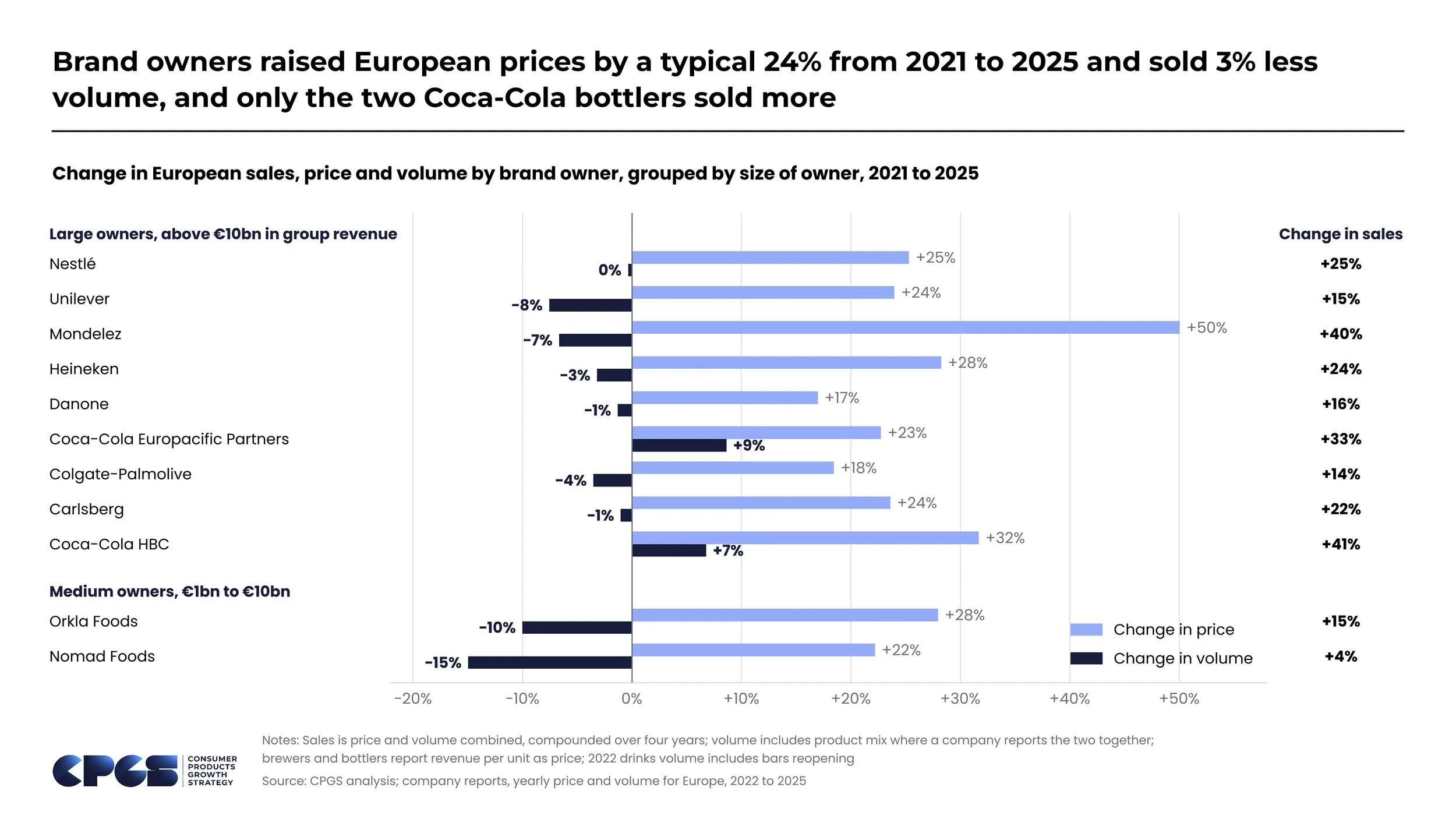
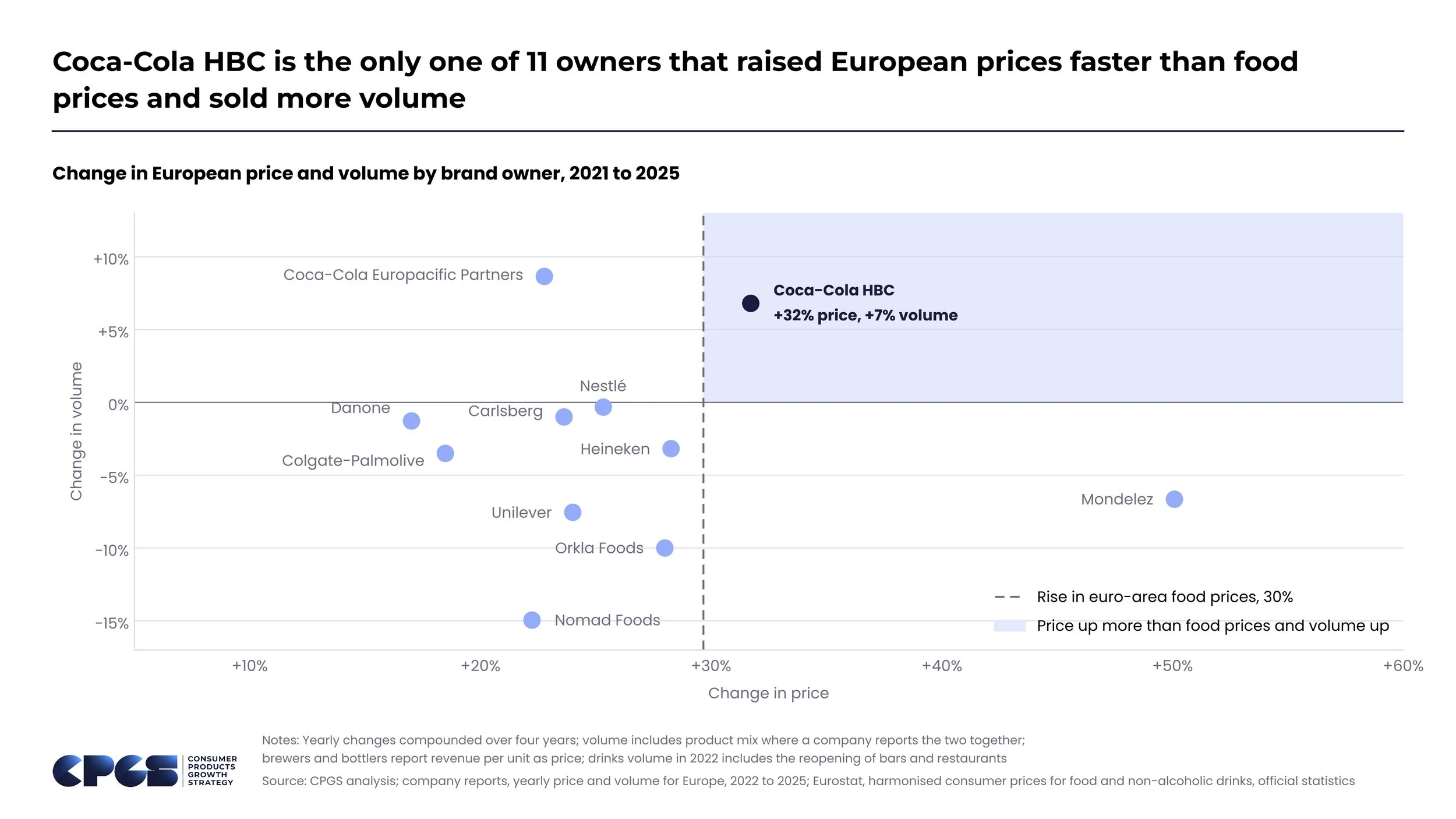
Over the past four years, brand owners in fast-moving consumer goods, which covers food, drink, household and personal care, have grown in Europe by charging more, not selling more. Across the 11 companies that report European price and volume performance, the typical company (median) raised prices by 24% between 2021 and 2025 while volumes fell 3%. Sales rose 22% for the typical company, so pricing accounted for all of the growth.
Price increases ranged from 17% to 50%. Eight of the 11 companies lost volume, Nestlé remained flat, and only the two Coca-Cola bottlers sold more. The two mid-sized companies raised prices at a similar rate to the nine largest groups and lost volume much faster. Orkla's food business raised prices by 28% and Nomad Foods by 22%, against 24% for the typical large group. Orkla's food business lost 10% of its volume and Nomad Foods 15%, against 1% for the typical large group. Mid-sized companies generally have less brand power than the largest groups, so the same price increase costs them more volume.
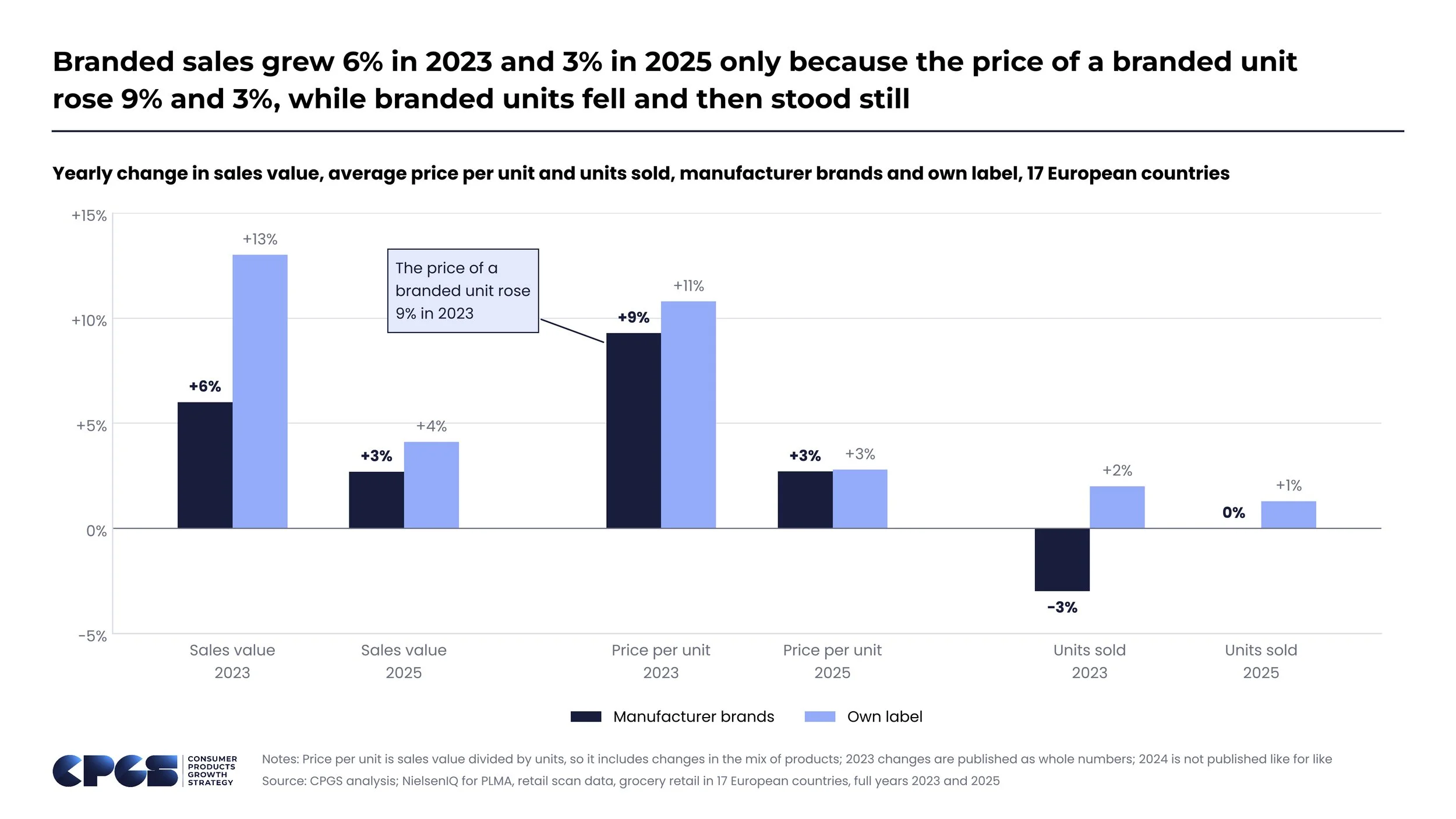
The same pattern emerges across the wider branded market, beyond the 11 companies. Across 17 European countries, branded sales value grew 6% in 2023 despite a 3% decline in units sold, according to NielsenIQ data for PLMA. In 2025, value growth slowed to 3%, while volumes remained flat. The average price per branded unit rose around 9% in 2023 and 3% in 2025. In both years, pricing accounted for all of the growth in branded sales in Europe.
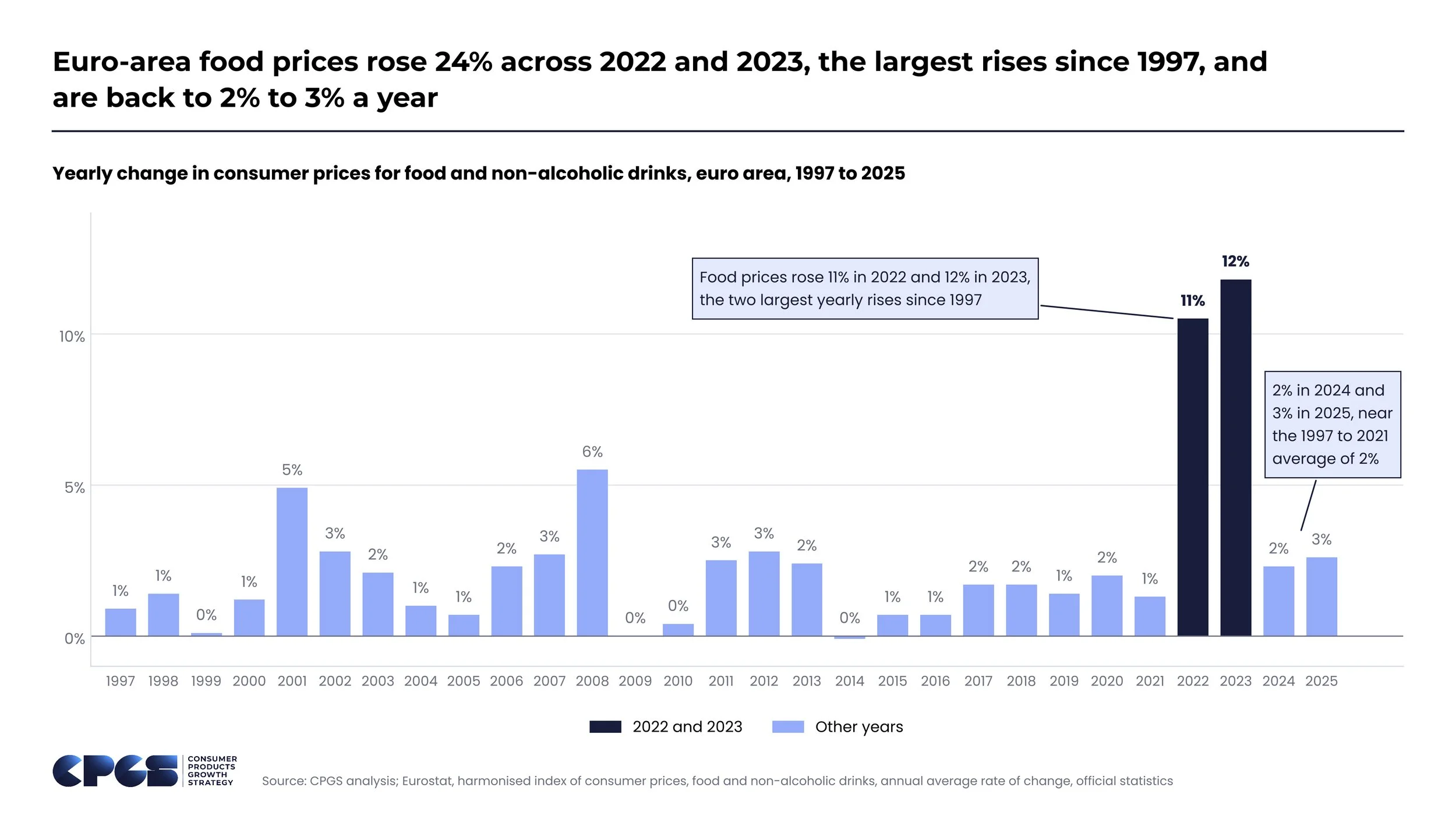
Until 2023, the environment favoured price increases, for two reasons. First, demand looked insensitive to price during the Covid period of 2020 and 2021, when households ate and drank more at home and volumes held. Second, food inflation then gave brand owners a justification to raise prices. Euro-area food prices rose 11% in 2022 and 12% in 2023, the two largest annual increases since Eurostat records began in 1997, compared with an average of around 2% a year between 1997 and 2021. Retailers and consumers were more willing to accept higher brand prices because inflation was widespread and rising costs provided a credible justification.
Food inflation returned to more historical levels in 2024 and 2025, at 2% and 3% respectively. Brand owners can no longer rely on the same inflationary environment to justify significant price increases. A brand raising prices above the market average now risks becoming noticeably more expensive relative to its competitors. Further price-led growth is therefore likely to come at a greater cost to volume.
Grocers are also pushing back on brand price increases because they are under pricing pressure themselves. Mainstream grocers are competing with discounters through price-match schemes, loyalty-card prices and own label. Circana reported in April 2026 that these tactics had intensified across Europe's six largest grocery markets. A grocer that accepts higher brand prices has to raise its own shelf prices, and higher shelf prices risk undermining the grocer's price competitiveness against other retailers.
The consequences are already visible in brand owners' financial results. Nestlé reported that temporary retailer delistings held back European volumes in Q2 2026. Campari's German sales fell 3% in 2025 after retailers delisted products when the company refused to lower prices, primarily on Aperol. Heineken reported disruption from prolonged retailer negotiations in France, the Netherlands, Germany and Spain. Orkla lost house care sales following delistings in the Benelux, while Valsoia held back sales of its Santa Rosa jams in Italy until new price agreements took effect in early 2026.
Ultimately, the ability of a brand to push through further price increases depends on how much a retailer stands to lose by not stocking it. Few brands have that bargaining power.
If brand owners want to keep growing sales without relying on price increases, they need to grow volumes. This means leaning on their other growth levers: stronger brands, better products, price promotions and wider or more effective distribution.
Most brand owners will fall back on pushing their brands harder. After all, the brand is arguably the most valuable asset of a consumer goods company. It is what makes shoppers choose one product over another and pay a premium for it. NIQ estimates that around 30% of a consumer goods brand's revenue comes from the strength of the brand itself.
But will strengthening the brand alone be enough to bring volume growth back?
The power of big brands is weakening, and building a brand is becoming harder
The challenge facing brand owners goes beyond the end of the inflationary cycle. Two of the traditional advantages of owning a large consumer goods brand are weakening: the ability to command a price premium and the ability to build consumer preference through advertising.
First, the pricing power of most brands is more limited than their owners might assume
Brand power can be assessed through two measures: how strong the brand is perceived to be and shoppers' willingness to pay more for it.
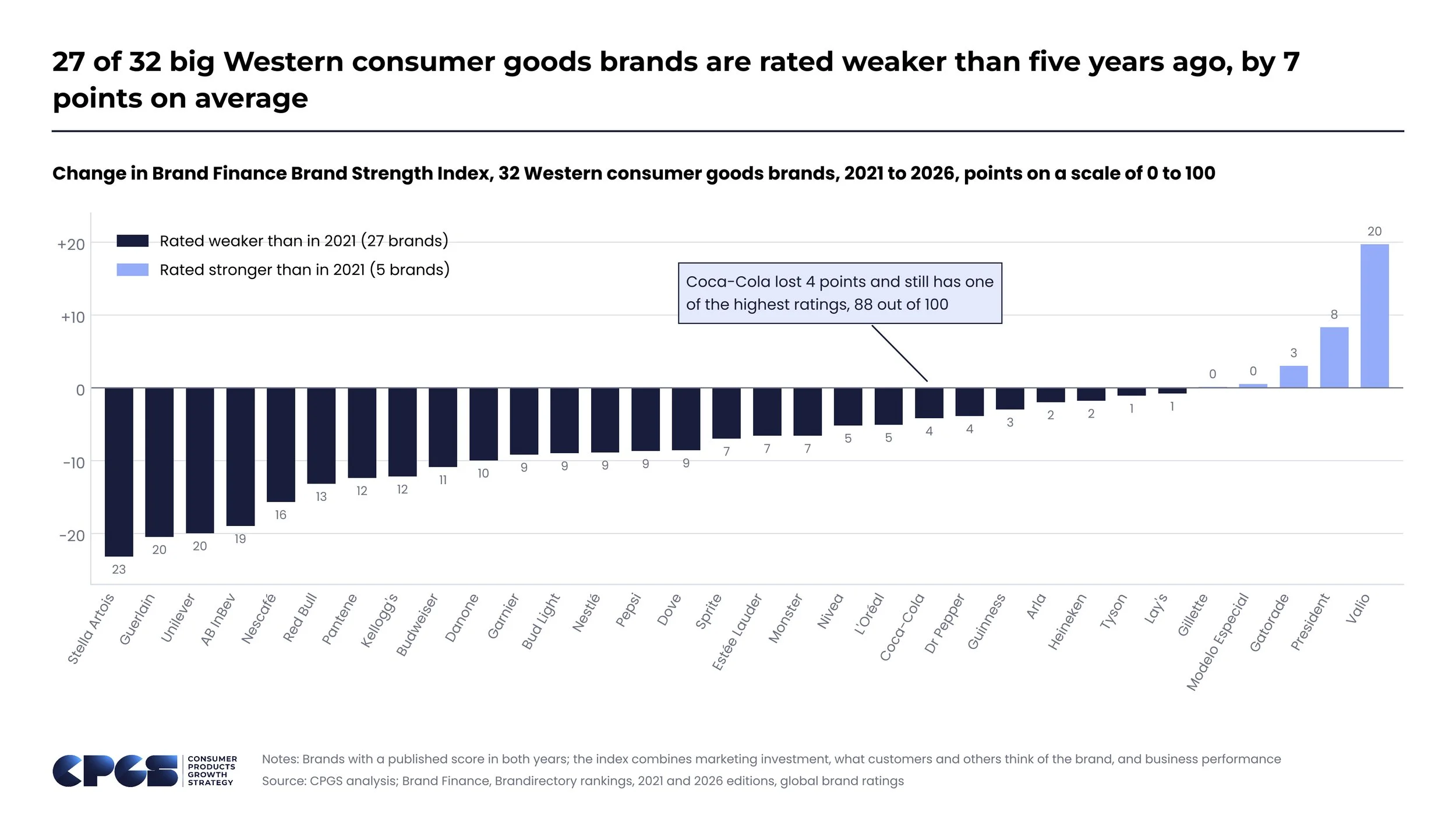
Most major consumer goods brands have become weaker. Brand Finance scores brands from 0 to 100 based on marketing investment, stakeholder perceptions and business performance. Of the 32 major Western consumer goods brands with comparable scores in 2021 and 2026, 27 lost strength. Across the 32 brands the average change was a fall of seven points, with Nescafé losing 16 points, Dove nine and Nivea five. The scores are global rather than European, and the index captures marketing investment and business performance alongside consumer perceptions. While not a direct measure of consumer loyalty, the deterioration across so many established brands points to a broader weakening of their competitive position.
Shoppers' willingness to pay a premium for brands has a ceiling. Pricing performance reinforces what declining brand strength ratings suggest. All 11 brand owners raised their European prices between 2021 and 2025, but nine increased them by less than the 30% rise in euro-area food prices. Seven of those nine still lost volume, despite becoming relatively cheaper against the wider food basket.
Food inflation is not the same as inflation within each company's categories, but the finding illustrates how difficult it has become for brand owners to retain volume even when their prices rise less than the broader cost of groceries.
Coca-Cola stands out as the exception. Coca-Cola HBC raised prices by 32% in its established European markets between 2021 and 2025, outpacing food inflation while growing volume by 7%. Coca-Cola Europacific Partners, the other major European bottler, raised prices by 23% and grew volume by 9% (the Coca-Cola brand is roughly 60% of both bottlers sales).
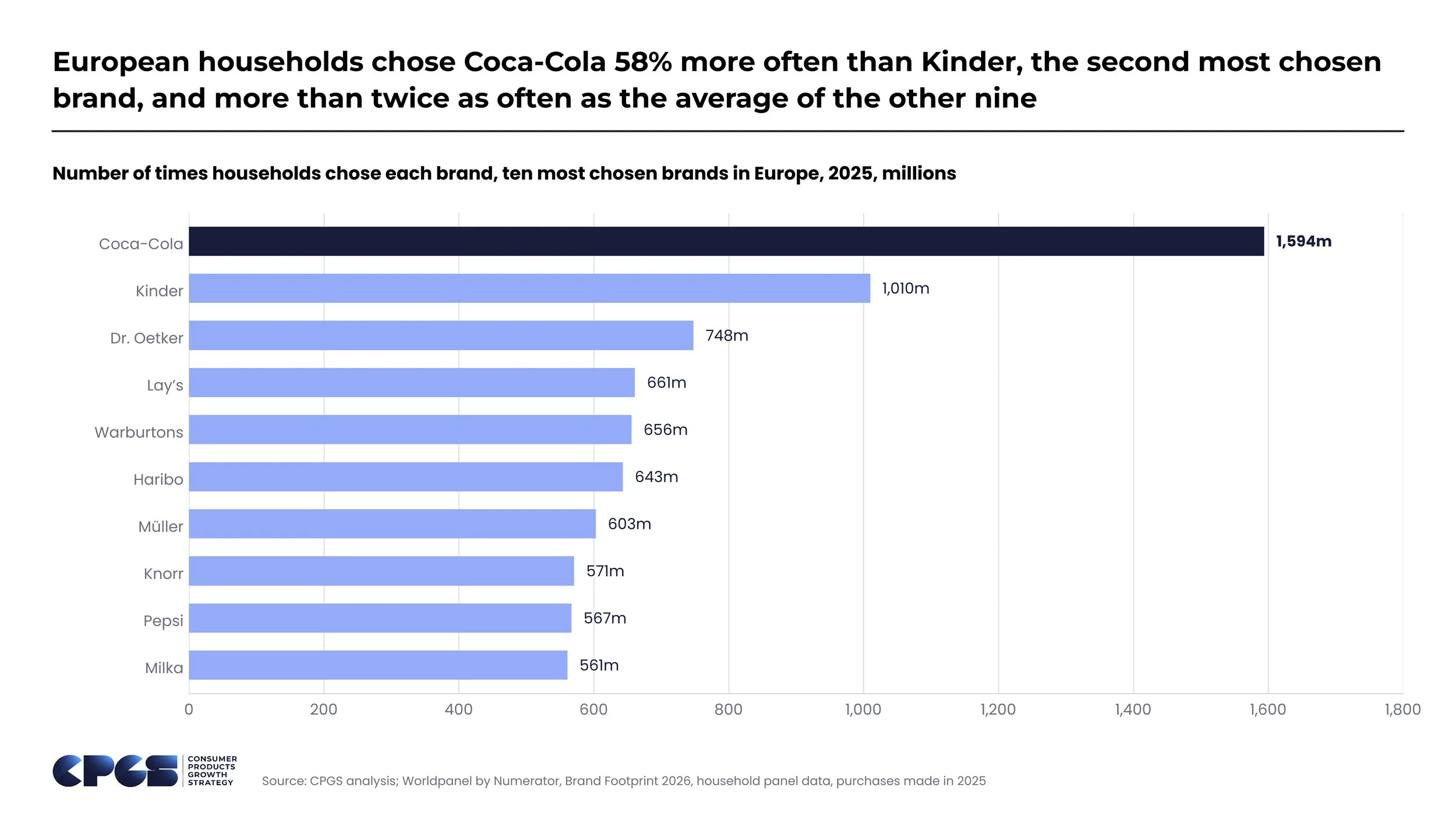
The Coca-Cola brand is exceptionally strong, and two separate measures show it. European households chose Coca-Cola 1.59 billion times in 2025, according to Worldpanel by Numerator, 58% more often than Kinder, Europe's second most chosen brand, and more than twice as often as the average of the other nine brands in the top ten. Households chose Coca-Cola almost three times as often as Pepsi. The gap between Coca-Cola and Kinder alone, 584 million choices, is larger than the total for Knorr, Pepsi or Milka, which are all among Europe's ten most chosen brands.
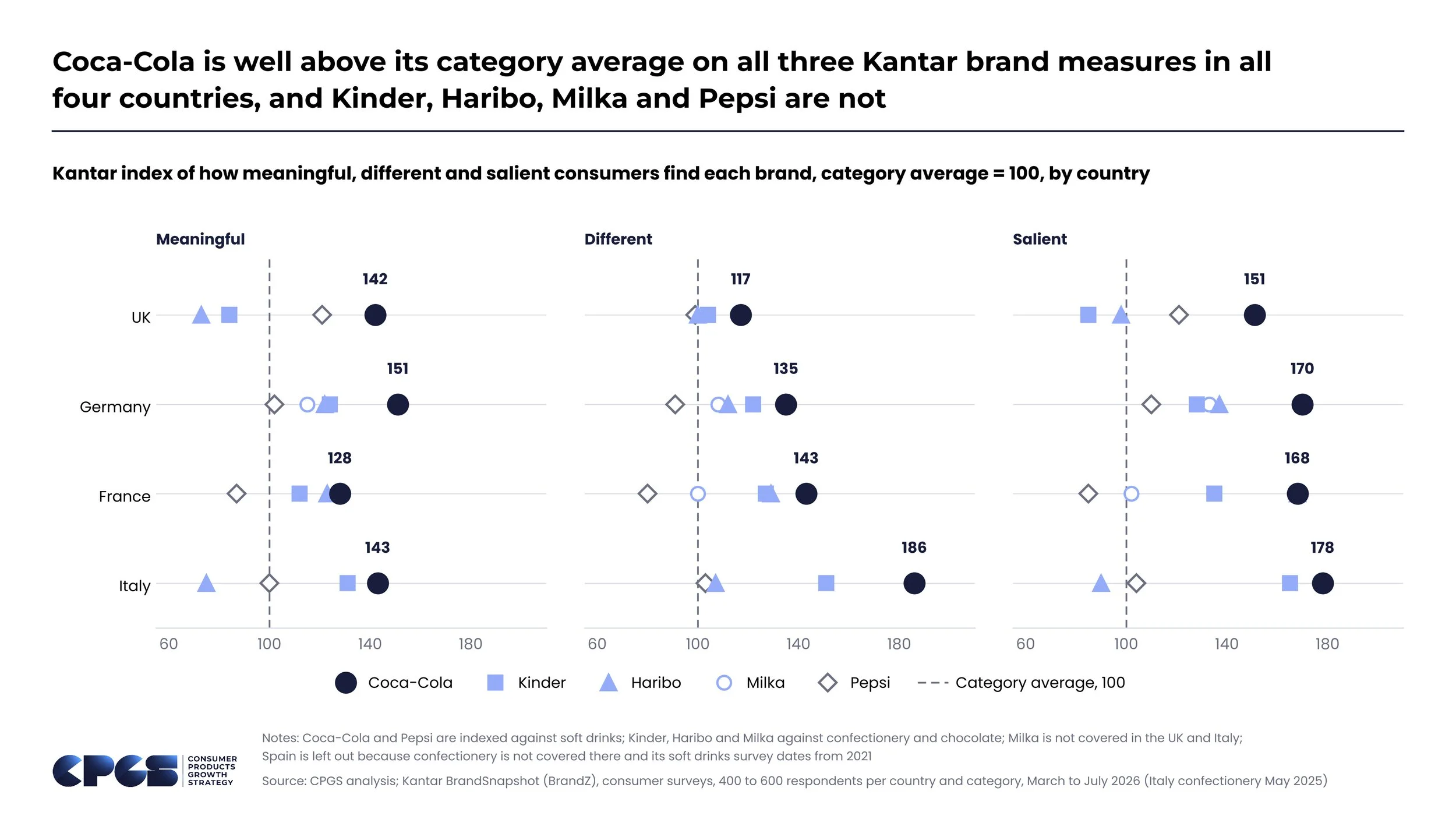
Kantar's consumer surveys show the same strength country by country. Kantar scores each brand on how meaningful, different and salient consumers find it, and a score of 100 is the average brand in the same category and country, soft drinks for Coca-Cola and Pepsi and confectionery for Kinder and Haribo. Across the UK, Germany, France and Italy, Coca-Cola averages 141 on meaningful, 145 on different and 167 on salient. Kinder averages 113, 126 and 128, Haribo 98, 112 and 123, and Pepsi 103, 93 and 105. Coca-Cola is the only one of these brands that scores well above its category average on all three measures in every country.
Coca-Cola's performance illustrates what exceptional brand power can help deliver, although category growth, distribution and portfolio mix also contribute to the bottlers' results. For most brand owners, building enough brand equity to achieve a similar outcome is unlikely to be a realistic growth strategy. They need to find other sources of competitive advantage.
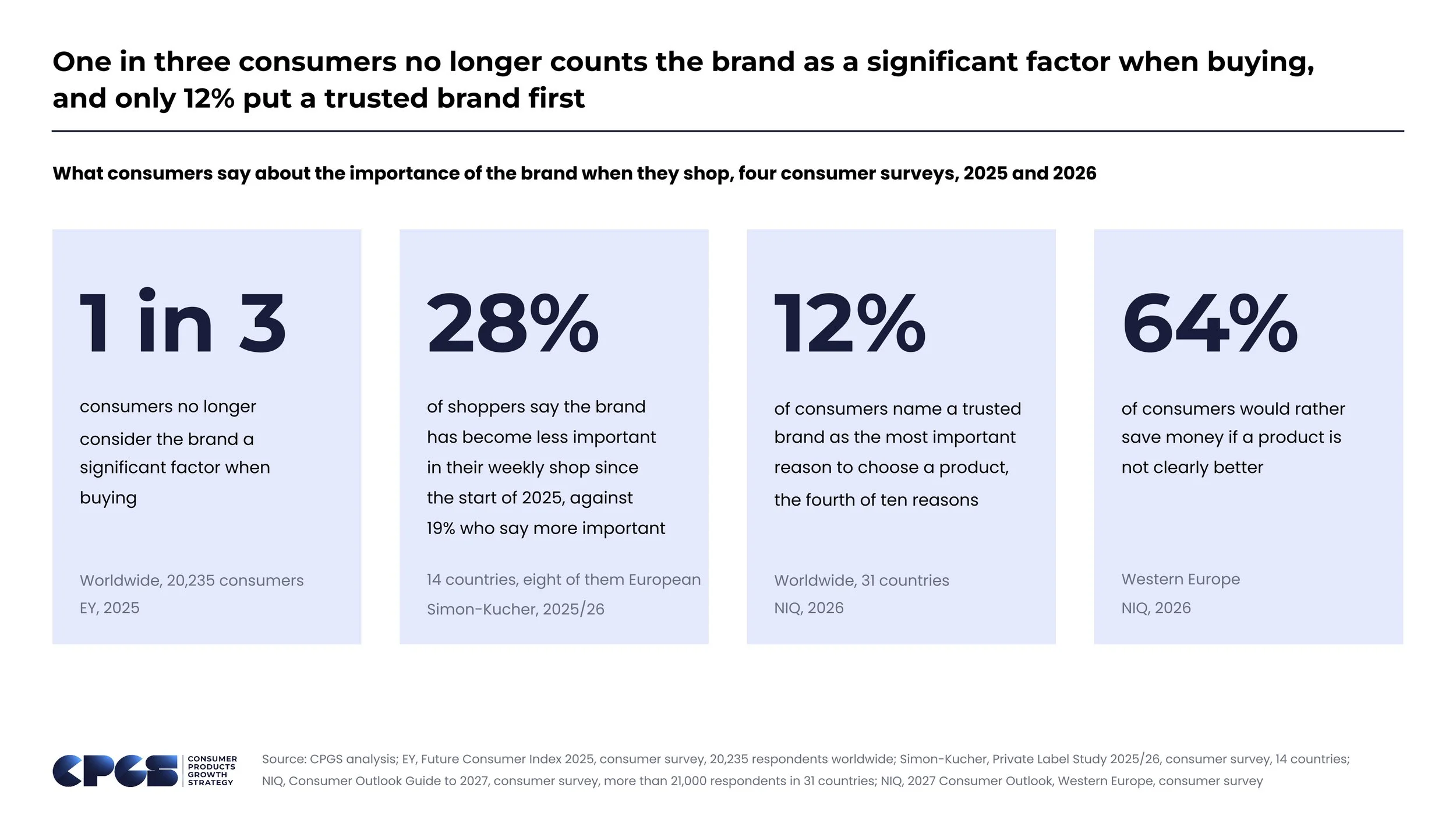
Consumers are also becoming less reliant on brands when making purchasing decisions. One in three no longer considers the brand a significant factor when buying, according to an EY survey of 20,235 consumers globally. A Simon-Kucher survey across 14 countries, eight of them European, found that 28% of shoppers considered brands less important in their weekly shop since the start of 2025, compared with 19% who considered them more important. Globally, only 12% of consumers cite a trusted brand as their primary reason for choosing a product, ranking fourth out of ten purchasing factors. In Western Europe, 64% of consumers would rather save money if a product is not clearly better.
Increasingly, the brand name alone is not enough to justify a price premium.
Second, building a brand is harder than ever
For decades, advertising was the primary lever for building brands and driving volume growth. Today, that lever is becoming harder to pull. Procter & Gamble's chief brand officer illustrated how brand building has changed: from mass-media reach, a single brand voice and a handful of advertisements a year to thousands of content assets, multiple voices and highly segmented audiences.
Other large companies describe the same change. Clorox now personalises 70% of its media spending, and its Pine-Sol brand has gone from targeting two audiences on social media to 107. Colgate-Palmolive has built a content supply chain designed for volume, speed and variety. Unilever shows how much more work brand building now takes. The number of content creators working on Unilever's Beauty and Wellbeing brands rose from 75,000 in 2024 to more than 180,000 in 2025. Its content production increased by 700%, its posting frequency doubled, and a piece of its content now lasts just four days. BCG counts more than 15 touchpoints on a shopper's path to purchase, compared with five a decade ago.
Large advertising budgets historically gave established brand owners an advantage in reaching consumers at scale. Fragmented media is changing that advantage. Large brands need to produce more content across more channels to reach their audiences, while smaller brands can reach specific groups of consumers at relatively low cost. Advertising remains important, but it is becoming harder to turn spending alone into a lasting competitive advantage.
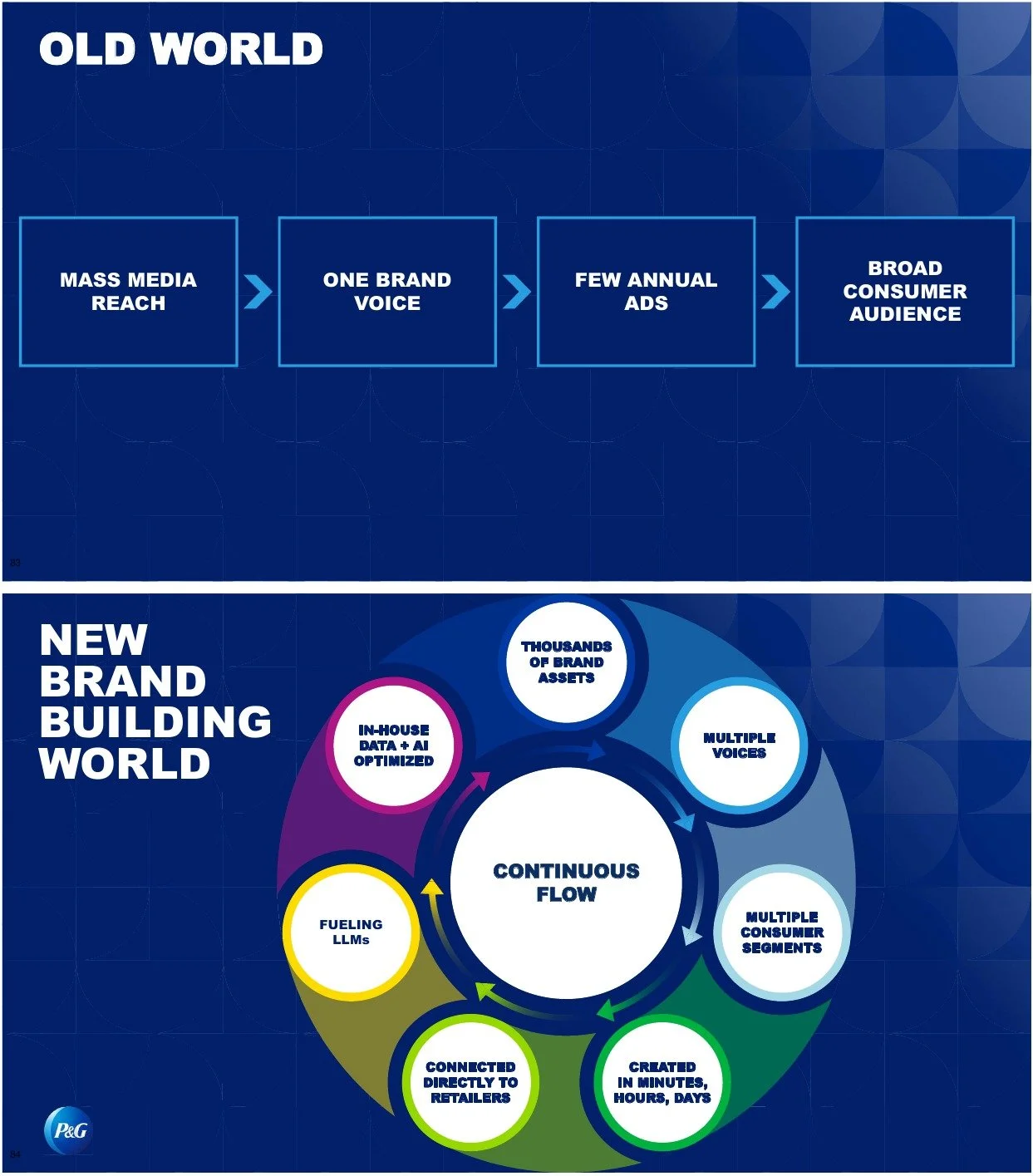
Source: Procter & Gamble, Investor Day 2026 presentation
Several major brand owners are responding by spending more. Between 2022 and 2025, Unilever increased brand and marketing investment from 13% to 16% of group turnover, while Reckitt increased its brand spending from 12% to 15%. Haleon and Nestlé each increased spending by around two percentage points of sales. Others, including Campari, Pernod Ricard and Ebro Foods, kept spending broadly stable as a share of revenue, and Diageo has since cut its marketing spending to 16% of sales in the year to June 2026. Brand building is becoming more complex, more resource-intensive and potentially less effective as a standalone driver of volume growth.
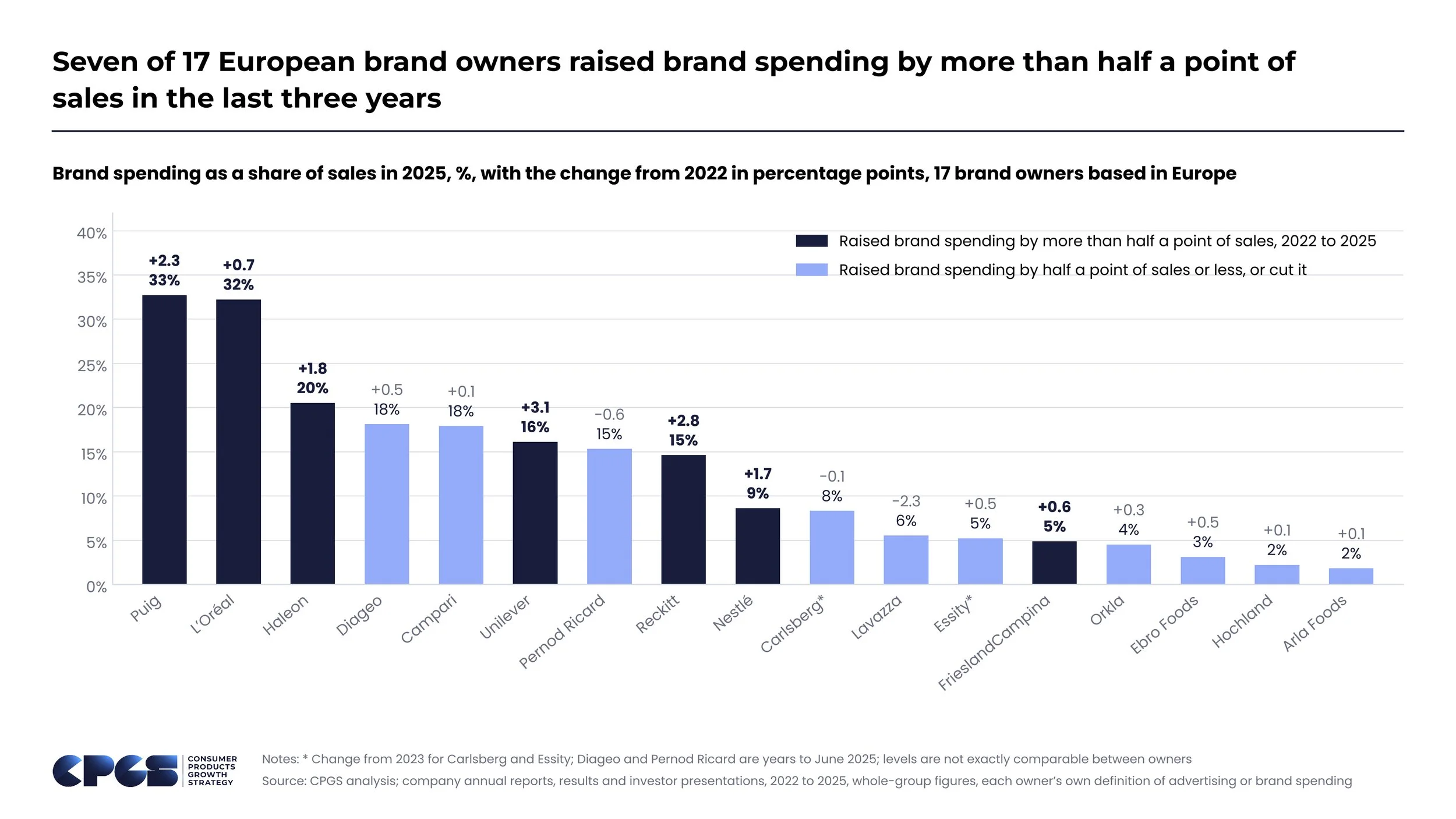
The next phase of growth requires a different allocation of investment: invest more in the product and concentrate brand investment on fewer brands
The years of price-led growth were largely a cycle driven by inflation. The weakening of traditional brand advantages is more structural, driven by retailer bargaining power, the growing competitiveness of own label and the fragmentation of media.
Brand owners should respond in two ways. First, concentrate brand investment on fewer brands where they have a realistic opportunity to build or sustain a competitive advantage. Brand building now takes more content, more channels and more money, making it increasingly difficult to support an entire portfolio effectively. Even so, brand owners should not fall into the trap of believing that the brand alone can carry volume, because there is only one Coca-Cola.
Second, and above all, invest more in the product. Product innovation is where a brand can still set itself apart, both from competing brands and from own label. A product that is clearly better gives shoppers a reason to choose it and pay a premium that the brand name alone may no longer justify.
Brand investment alone is unlikely to be enough, and the product now deserves a larger share of the budget.
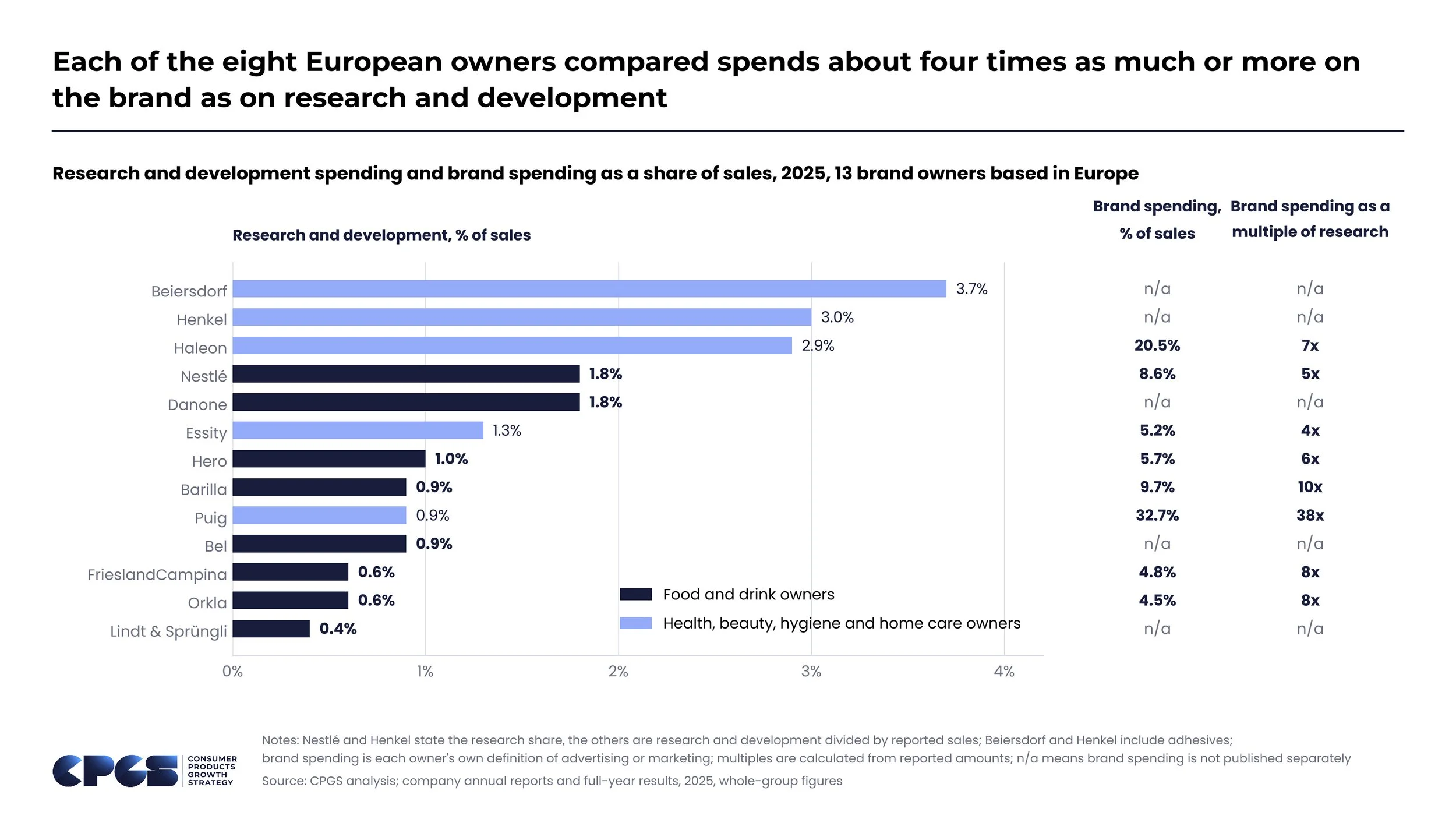
Brand owners have not invested in the product on the scale they have invested in the brand. Each of the eight European owners compared spent about four times as much or more of its sales on the brand as on research and development in 2025. Nestlé spent 9% of sales on the brand and 2% on research and development. Barilla spent 10% on the brand and 1% on research and development, and Hero spent 6% and 1%. FrieslandCampina and Orkla each spent about 5% on the brand and less than 1% on research and development. Haleon spent about 20% on the brand and 3% on research and development.
AI shopping tools could make the product count even more and reduce the importance of brand familiarity in purchasing decisions. A quarter of consumers worldwide used generative AI shopping tools in 2025 and a further 31% plan to use them, according to Capgemini. An AI tool compares what can be measured, such as price, ratings, ingredients and nutritional value. In an experiment across 17 AI models, a higher product rating raised the chance that an AI agent chose a product by 30 to 80 points in 14 of the models, against 5 points for human shoppers. AI tools reward a lower price as well as a higher rating. The experiment across 17 AI models also found that 13 of the models favoured the cheaper product, by 15 to 34 points, against 9 points for human shoppers. AI already shapes what shoppers buy. Worldwide, 55% of consumers say AI recommendations have influenced a consumer goods purchase and 27% already use AI tools to help decide what to buy, according to NIQ. In Europe the habit is at an earlier stage, and 12% of the European consumers surveyed by McKinsey in 2026 use generative AI for grocery shopping. A brand owner should make sure its product wins on what an AI tool can compare.
Brand owners should plan on the basis that price rises above the market will cost them volume and shelf space, even if costs rise again in 2027. The gap between a few strong brands and the rest is likely to widen over the next five years, unless grocers accept price rises again or branded units return to growth. The companies that grow volume again will be the ones whose product gives shoppers a reason to choose it.
Consumer goods companies have been through two investment cycles in recent years. The first centred on brand investment and cost cutting. The second centred on price increases and revenue growth management. We believe the next should centre on product innovation.
Brand investment remains important, but its ability to generate incremental volume is likely to be weaker than before. The brand owners that grow over the next five years will be those that give shoppers a better reason to buy, not simply more reasons to remember the brand.
Sources
CPGS analysis of company reports and investor presentations, 2022 to first half 2026: Danone, Colgate-Palmolive, Unilever, Coca-Cola Europacific Partners, Nestlé, Coca-Cola HBC, Mondelez, Lindt & Sprüngli, Beiersdorf, Reckitt, Haleon, Campari, Heineken, Carlsberg, Orkla, Nomad Foods, Valsoia, Diageo and 20 brand owners based in Europe.
Eurostat, harmonised consumer prices for food and non-alcoholic drinks, euro area, 1997 to 2025.
NielsenIQ for PLMA, A Mosaic of Markets, 2026; retail scan data, 17 European countries, 2023 and 2025.
Worldpanel by Numerator, Brand Footprint 2026; household panel data, purchases made in 2025.
Brand Finance, Brandirectory rankings, 2021 and 2026 editions.
NIQ, How brand tracking is letting you down, 2026.
NIQ, Consumer Outlook Guide to 2027; consumer survey of more than 21,000 respondents in 31 countries.
NIQ, 2027 Consumer Outlook, Western Europe; consumer survey.
Simon-Kucher, Private Label Study 2025/26; consumer survey in 14 countries.
EY, Future Consumer Index, 2025; consumer survey of 20,235 respondents.
BCG, How AI Is Rewriting CPG Marketing Economics, 2026.
Procter & Gamble, Investor Day 2026 presentation.
Unilever, CAGNY 2026 presentation.
Capgemini, What matters to today's consumer 2026; consumer survey.
McKinsey, State of Grocery Retail 2026: Europe; consumer survey of 15,566 respondents in 14 European countries.
Cherep and others, A Framework for Studying AI Agent Behavior: Evidence from Consumer Choice Experiments, 2025; experiment across 17 AI models.
NielsenIQ, The Power Shift, 2026; retail scan data and consumer survey, Western Europe.
EY, What it takes to maintain brand relevance in an era of endless choice, March 2025; consumer survey.
Circana, April 2026; retail scan data, Europe's six largest grocery markets.
Clorox, CAGNY 2026 presentation.
Colgate-Palmolive, CAGNY 2026 presentation.
Kantar, BrandSnapshot powered by BrandZ; consumer surveys in the UK, Germany, France and Italy, 2025 and 2026.