
The discount boom is over in most of Europe. Hard discounters have stopped gaining share in the markets that make up most of Europe's discount spending. Almost all the growth they have left sits in four countries: Poland, Britain, Spain and the Netherlands. Their share across the eleven markets is about 22%. Even if the chains open every shop they have announced, it reaches only 22% to 24% by 2031. Only a new food price shock would take it much higher. Forecasts that still assume a steady climb across Europe are too optimistic. For brand owners, we think the bigger price threat now comes from the mainstream grocers that lead on price, such as Leclerc, Mercadona and Tesco.
Discounters won their share in the price shock, and they have grown since only by opening shops
Hard discounters such as Aldi, Lidl, Biedronka and Penny sell a short range of mostly own-label products at the lowest prices. Supermarket chains with low prices, such as Mercadona in Spain, are not hard discounters.
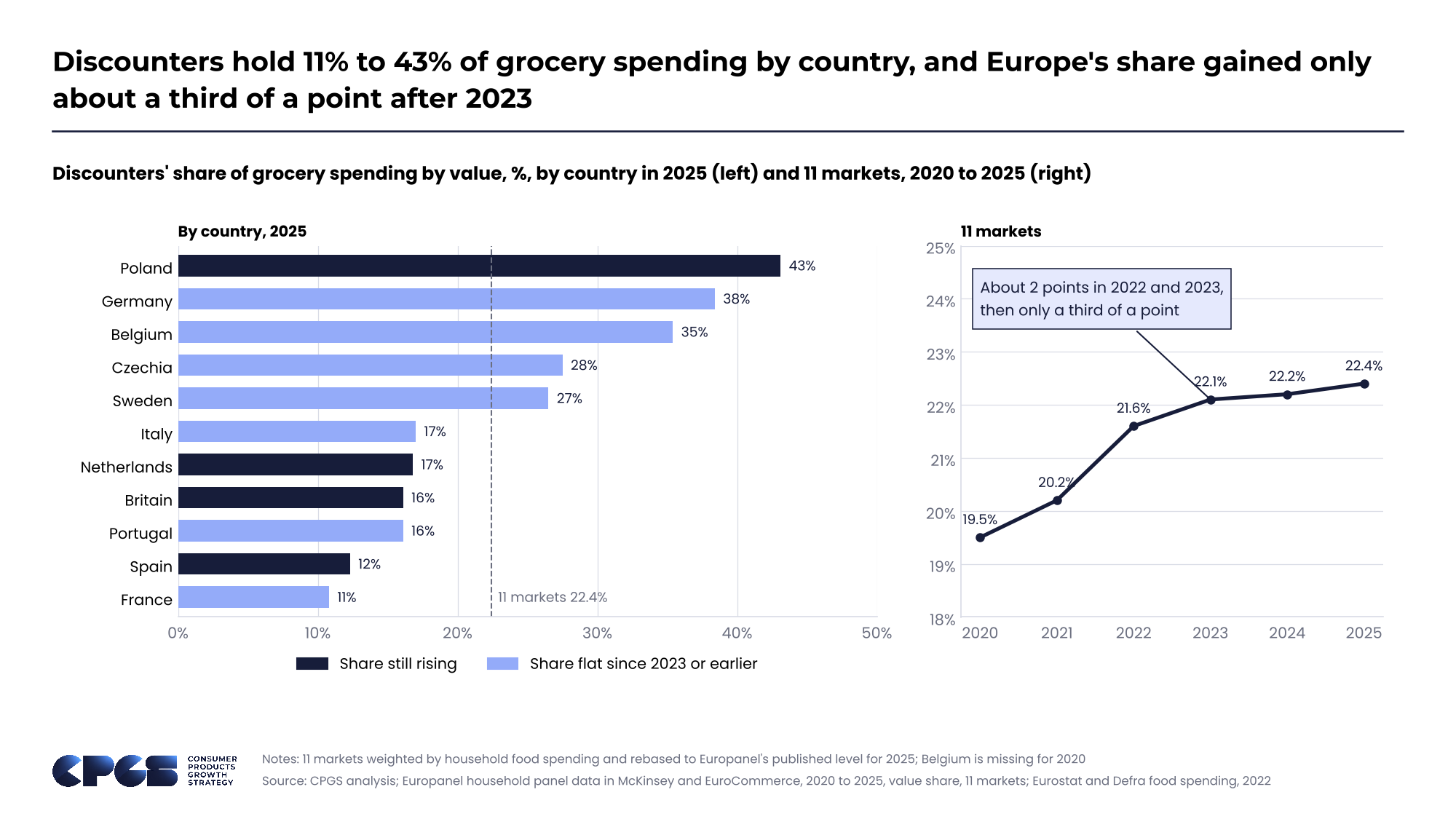
Across the eleven European markets that Europanel tracks, hard discounters took about 22% of grocery spending in 2025 (McKinsey and EuroCommerce, State of Grocery Retail Europe 2026, Europanel household panel).
Discounters hold 43% of grocery spending in Poland and 38% in Germany. In France they hold 11%, and in Spain 12%. Most of the recent European gain came in 2022 and 2023, when food prices jumped and households traded down. The share rose about 2 points in total between 2021 and 2023. It has added only about a third of a point since then (CPGS analysis of Europanel country shares).
Source: CPGS analysis; Europanel household panel data in McKinsey and EuroCommerce, 2020 to 2025, value share, 11 markets; Eurostat and Defra food spending, 2022
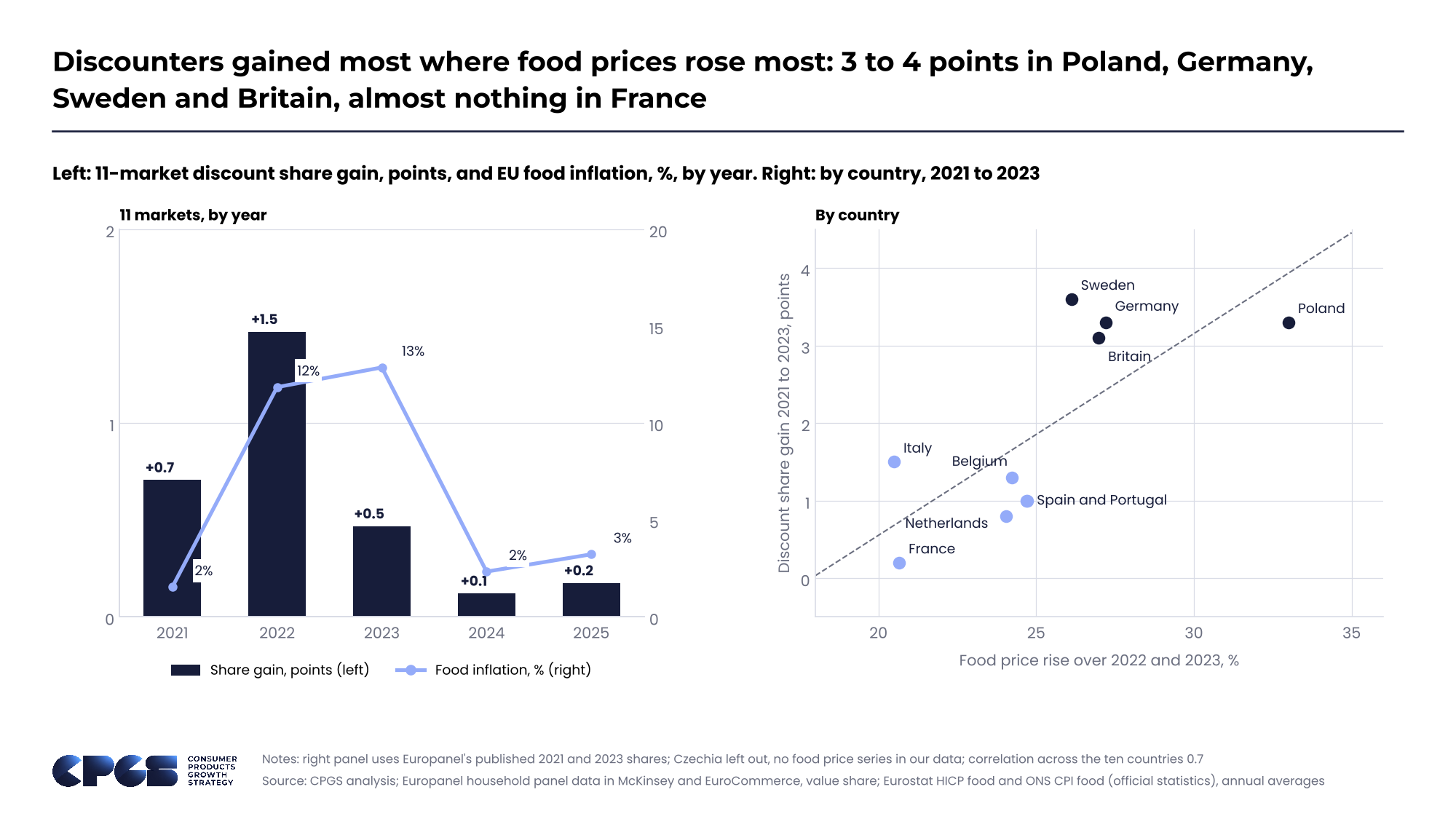
Discounters gained most of their share while food prices were rising fastest. Across ten of the markets, discounters gained most in 2022 and 2023 where food prices rose most. Poland, Germany, Sweden and Britain each gained 3 to 4 points of share, with food prices up 26% to 33% over the two years. France gained almost nothing, with one of the smallest price rises, about 21% (Europanel; Eurostat; ONS). The year-by-year figures also fit food prices as the cause, although our 2022 figure is an estimate. Across the eleven markets the share jumped by about one and a half points in 2022, the year food prices first jumped. It gained far less in 2023, even though prices kept rising. When food inflation fell back in 2024 and 2025, discounters gave none of that gain back. Their share held and edged up by about a third of a point. Our view is that the price shock moved shoppers to discounters once, and they stayed. It did not start a steady climb.
Source: CPGS analysis; Europanel household panel data in McKinsey and EuroCommerce, value share; Eurostat HICP food and ONS CPI food (official statistics), annual averages
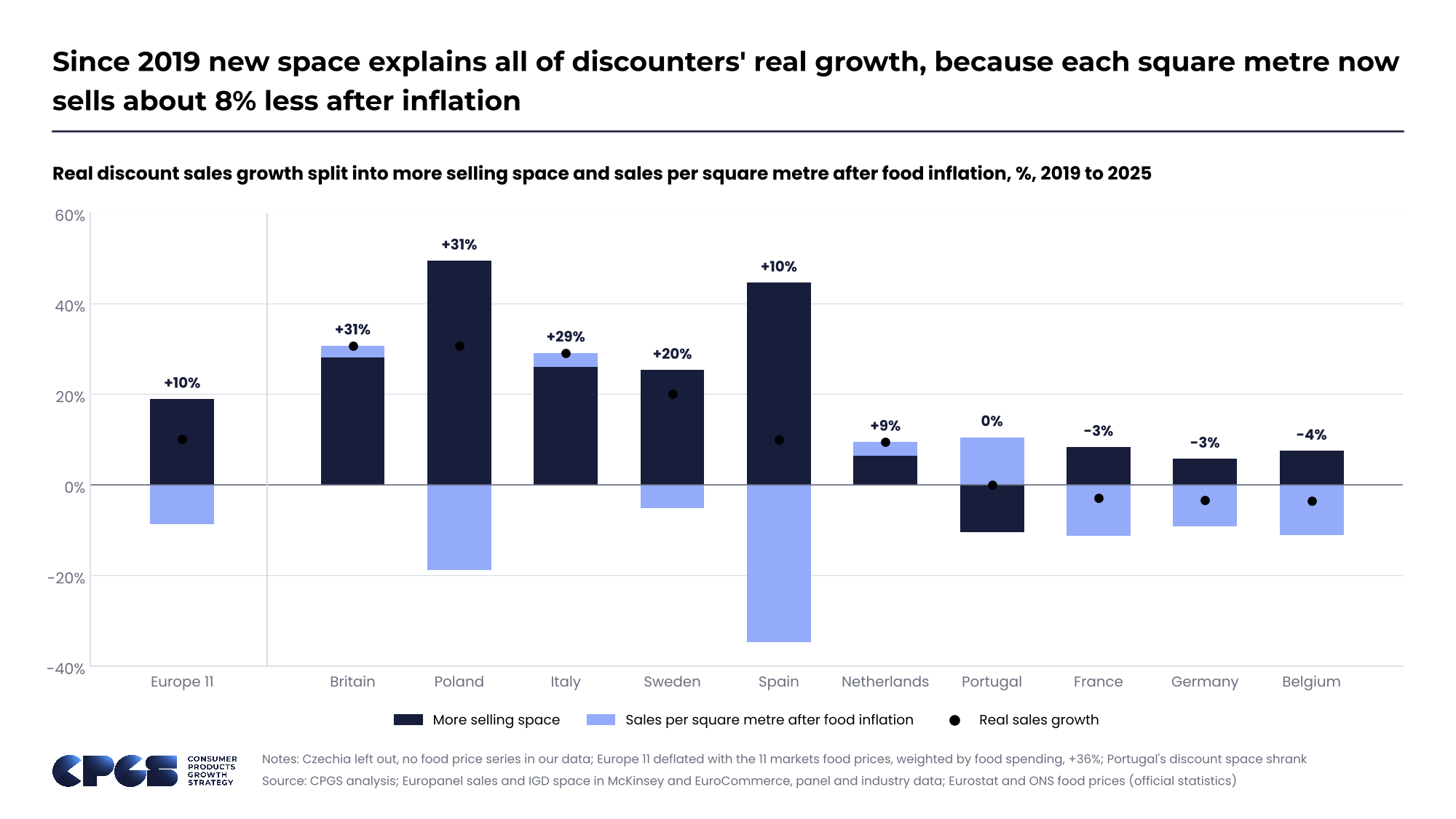
Discounters have grown mainly by opening new shops. Discount selling space grew 20% between 2019 and 2025. All modern grocery space, including discounters, grew only 5%. (McKinsey and EuroCommerce, State of Grocery Retail Europe 2026, IGD space data). Discount value sales grew 50% over the same years, but food prices rose about 36% across the eleven markets. After inflation, discount value sales grew only about 10%. This means that each square metre of discount shop sold about 8% less, against about 5% less for all modern grocery (CPGS analysis of Europanel sales, IGD space and Eurostat food prices). So new space explains all of the real growth discounters experienced in the last years. In Spain, discount space grew 52%, but each square metre sells 28% less after inflation. In Poland, space grew 53% and real sales per square metre fell 15%. In France, Germany and Belgium discounters added a little space and still sold less after inflation. Among the markets that added space, sales per square metre rose after inflation only in Britain, the Netherlands and Italy (about +3%).
Source: CPGS analysis; Europanel sales and IGD space in McKinsey and EuroCommerce, The State of Grocery Retail Europe 2026, panel and industry data, 2019 to 2025; Eurostat and ONS food prices (official statistics)
Seven of the eleven markets have stopped gaining share
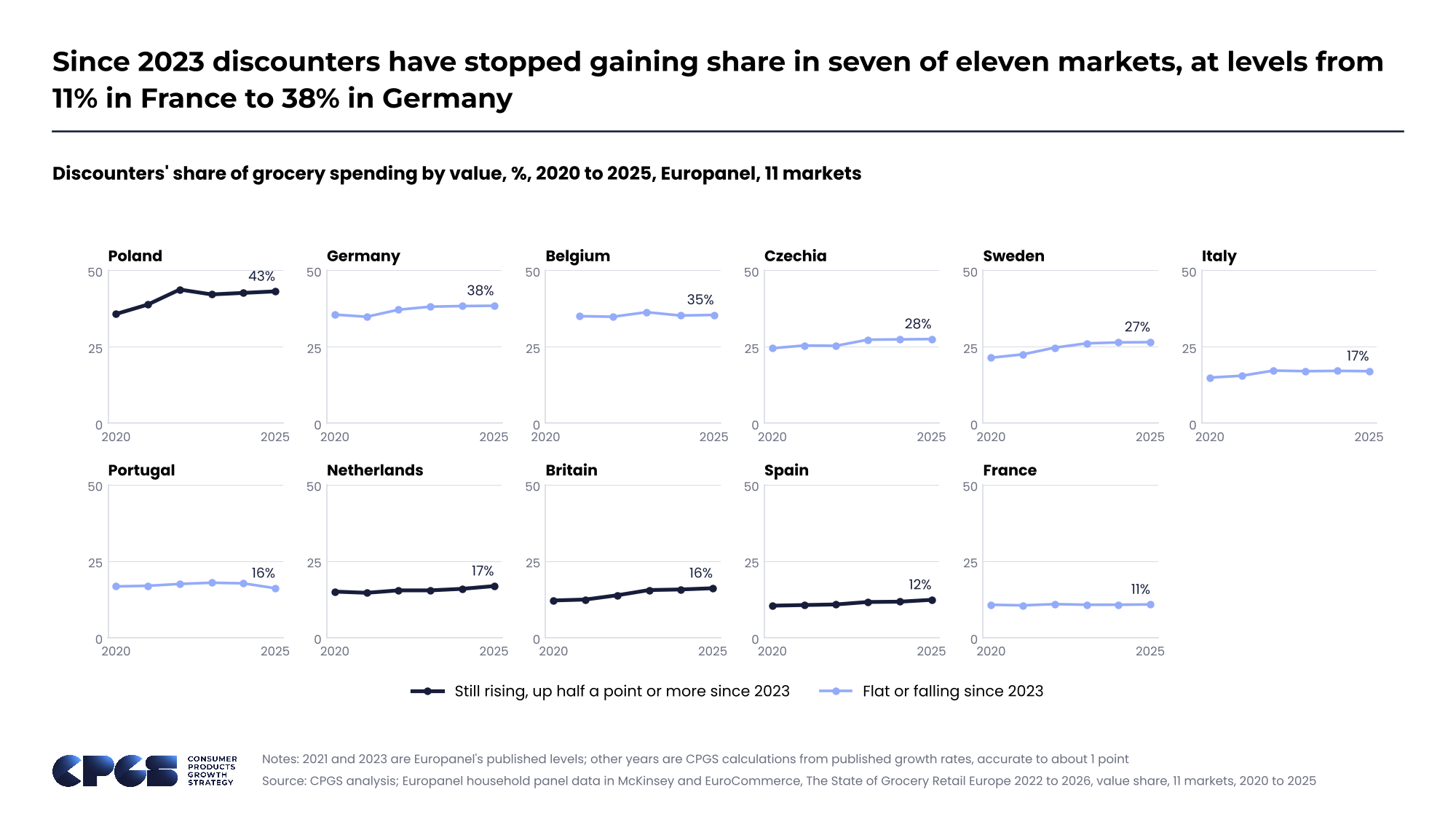
Since 2023 the discount share has stopped rising in most of the eleven markets. This is share of spending. Where discounters cut their prices, they can sell more volume while their share of spending stands still. In Poland, Biedronka's existing shops sold about 5% more volume in the first nine months of 2026, while their value sales fell slightly. From 2023 to 2025 the discount share rose in only four markets. It gained about one and a half points in the Netherlands, one point in Poland and about two thirds of a point in Spain and Britain. In Germany, Sweden and Czechia it rose by only a few tenths of a point, too little to count as a rise. It was flat in Italy and France, and it fell in Belgium and Portugal (CPGS analysis of Europanel shares). Each country share of discounters stopped at a different level. There is no single European ceiling that every market is moving towards.
Source: CPGS analysis; Europanel household panel data in McKinsey and EuroCommerce, The State of Grocery Retail Europe 2022 to 2026, value share, 11 markets, 2020 to 2025
Sweden's leading discount supermarket is now growing more slowly than the market. Europanel puts its discount share at about 27%, flat since 2023. Willys, the country's leading discount supermarket, grew sales 2% in the third quarter of 2026 while the market grew 4%. It was the second quarter in a row behind the market. Yet Willys kept opening shops, from 256 at the end of 2025 to 261 (Axfood, Q3 2026 interim report). Axfood wrote that "Willys holds a very strong position but grew at a slower pace than the market in the third quarter" (Simone Margulies, CEO, Axfood, Q3 2026 interim report, 22 October 2026).
Past a point, new discount shops add little share. In Italy discount selling space grew by about a quarter between 2019 and 2025, and the share has not moved since 2023. The new shops add sales, but the existing shops lose about as much. When new shops add little share, the market has reached its ceiling.
How high can discounters go in each country?
What is each country's ceiling for hard discounters? What sets it? And where is there still room to grow over the next five years?
Mainstream grocers set the ceiling, and only four markets have room left
Our view is that the ceilings are real and that mainstream grocers set them. In the seven stalled markets the ceiling is today's share: about 38% in Germany, 35% in Belgium, 27% to 28% in Sweden and Czechia, 17% in Italy, 16% in Portugal and 11% in France. Four markets still have room, but not much. By 2031 Britain can reach about 18%, from 16%. Spain can reach about 14%, from 12%. Poland can reach about 45%, from 43%. The Netherlands can reach about 21% at most, from 17%. Across the eleven markets that takes the discount share from about 22% to between 22% and 24%, depending on small moves in the stalled markets. In Britain and Spain the growth sits with Lidl, whose sales per shop are still rising, rather than with Aldi. In Poland, Biedronka is still winning shoppers by cutting its prices. Four findings support that view.
Mainstream grocers set the ceiling. Where a big grocer already sells close to discount prices, shoppers who want low prices do not need a discounter. In France, Leclerc's share rose from 22% to 24% between early 2021 and early 2026. Lidl and Aldi together moved only from 10% to 11% (Worldpanel by Numerator, 12 weeks to March). UFC-Que Choisir ranks Leclerc the cheapest grocer that is not a discounter (price survey, 2025). Carrefour is cutting prices too. It cut about 8% on more than 500 products in August 2026 (Carrefour, Q3 2026 sales release). So French discounters face two mainstream grocers fighting on price.
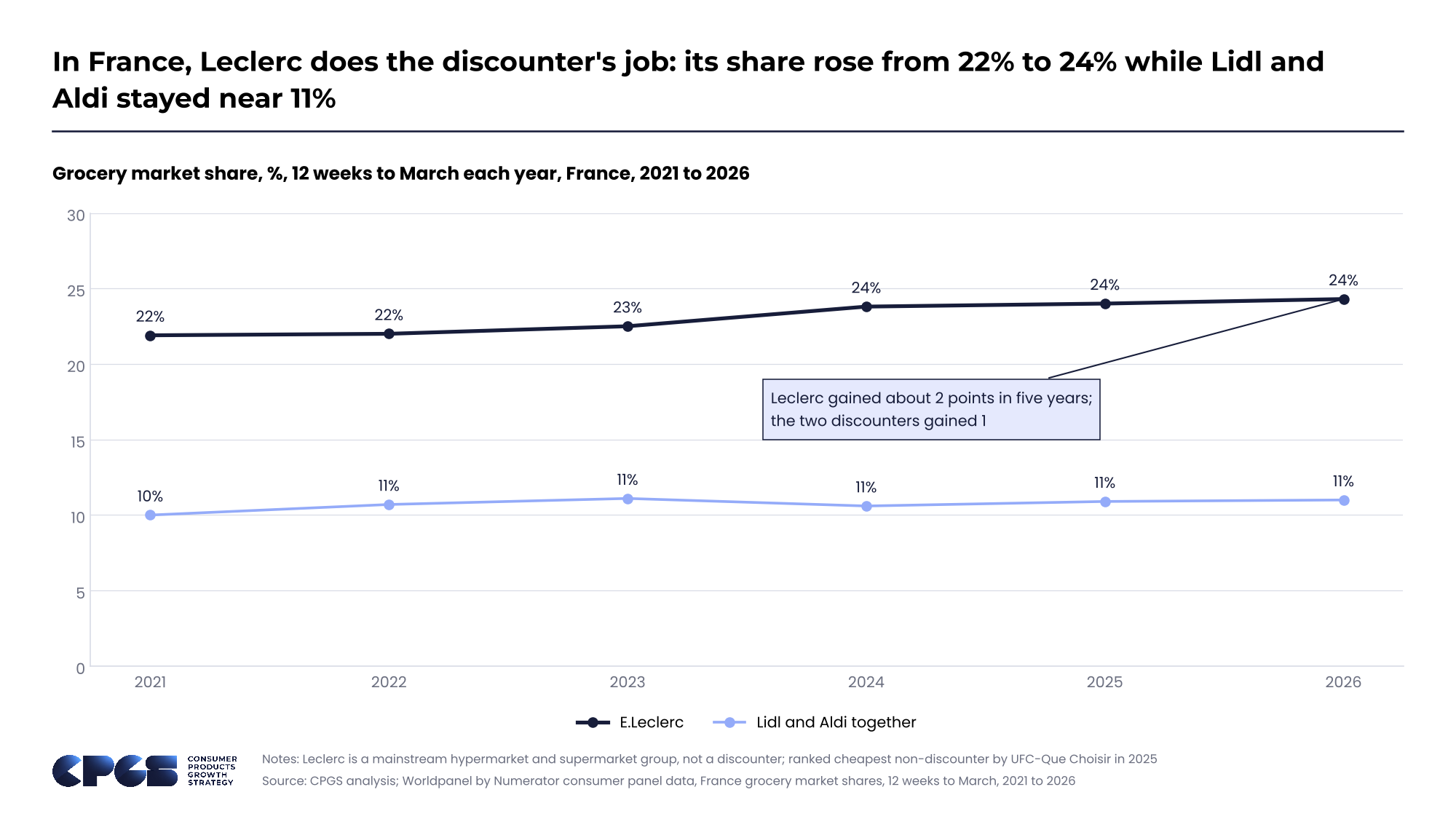
Source: CPGS analysis; Worldpanel by Numerator consumer panel data, France grocery market shares, 12 weeks to March, 2021 to 2026
Spain and Britain are still rising, but from the bottom of the table. France and Spain have the two lowest discount shares of the eleven markets, at 11% and 12%. Britain and Portugal come next at 16% (Europanel, 2025). We think the price leaders cap the level discounters can reach. In Spain, Mercadona holds 27% of grocery spending (Worldpanel by Numerator, January to August 2026). Mercadona is a soft discounter: a full supermarket with a short range, a strong own label and very aggressive everyday prices. Its share is more than twice the whole hard discount share of 12%. In Britain, Tesco keeps about 700 products priced to match Aldi. In October it told analysts: "we continue to be very strong on holding the 700 or so Aldi Price Match lines" (Imran Nawaz, Tesco, interim results call, 8 October 2026). Matching on the products shoppers compare costs margin. But it keeps the ceiling where it is. The timing in Britain fits this view, though it does not prove it. Aldi's share was flat or down for much of 2024, when Tesco and Sainsbury's matched Aldi on the most products. It rose again from December 2024, after both chains cut their lists (The Grocer, 2025, from Kantar data).
Discount brands are growing, but the price leaders have stronger brands. Brand Finance values Aldi Süd at USD 19.4bn in 2026, up 15%, and Lidl at USD 18.6bn. It says discount brands have grown in value about three times faster than full-service grocers since 2023 (Brand Finance, Retail 100, 2026). In Kantar's 2025 brand study, Lidl and Aldi come to mind more readily than the average grocer in all five countries measured. But only in Germany do they match the three biggest grocers, with an index of 108. In France, Spain, Britain and Italy they sit at 72 to 78. There Leclerc, Mercadona, Tesco and Conad hold the shopper's mind (Kantar brand equity survey, 2025). Brand Finance rates Mercadona the strongest retail brand in the world in 2026, and Tesco the fourth. A discounter struggles to pass a grocer that is both as cheap and as well known.
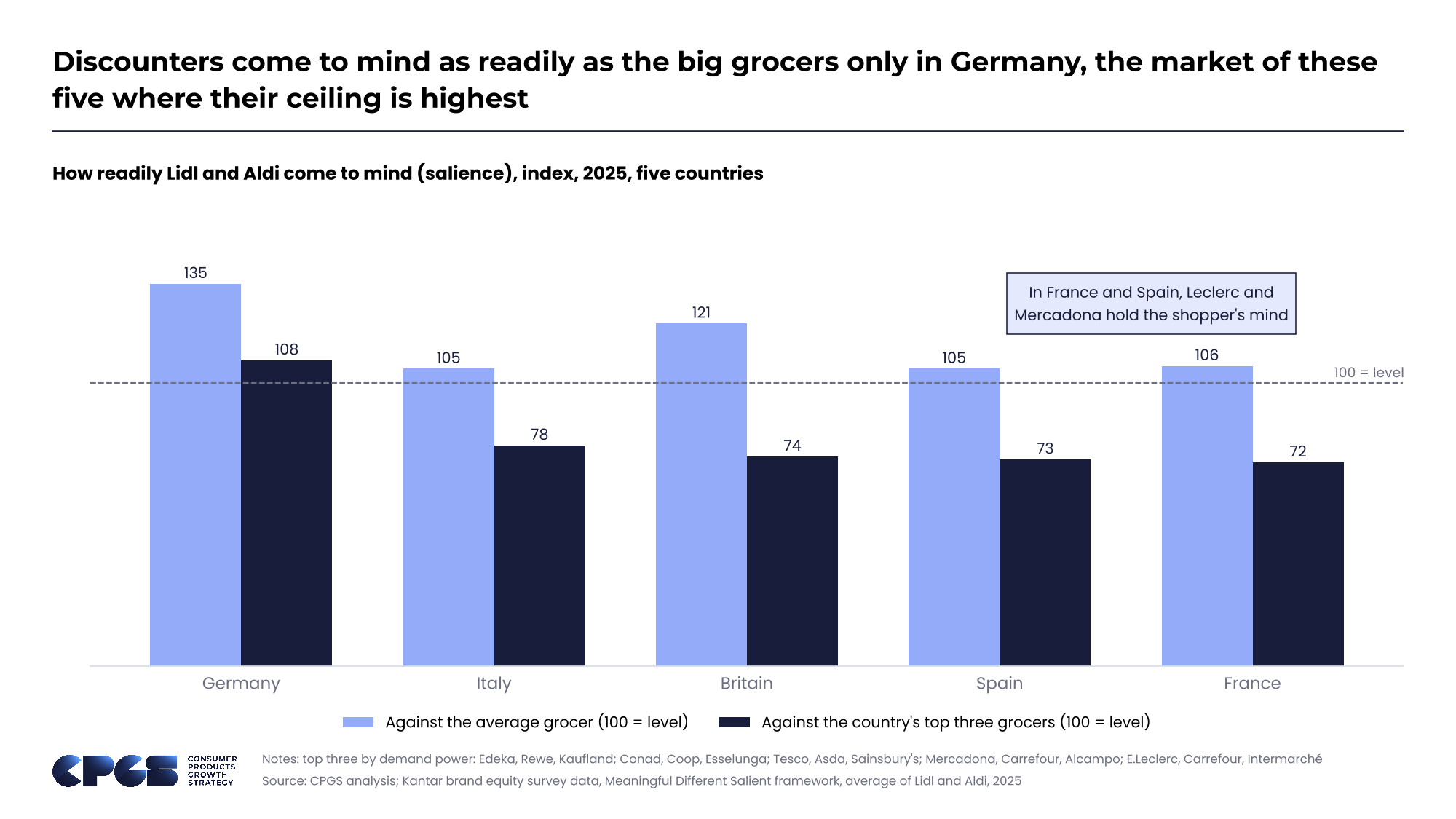
Source: CPGS analysis; Kantar brand equity survey data, Meaningful Different Salient framework, consumer survey, average of Lidl and Aldi, 2025, sample size not available
Discounters can still grow only where new shops win share from other grocers. Discounters are announcing openings almost everywhere. In Poland and Spain the main chains plan to open up to 10% of their shop count each year. In Britain and Czechia the figure is 3% to 5%. Italy opens at up to 7% a year, yet its discount share has been flat since 2023. There, new shops mostly take sales from existing ones (company announcements, 2025 to 2026).
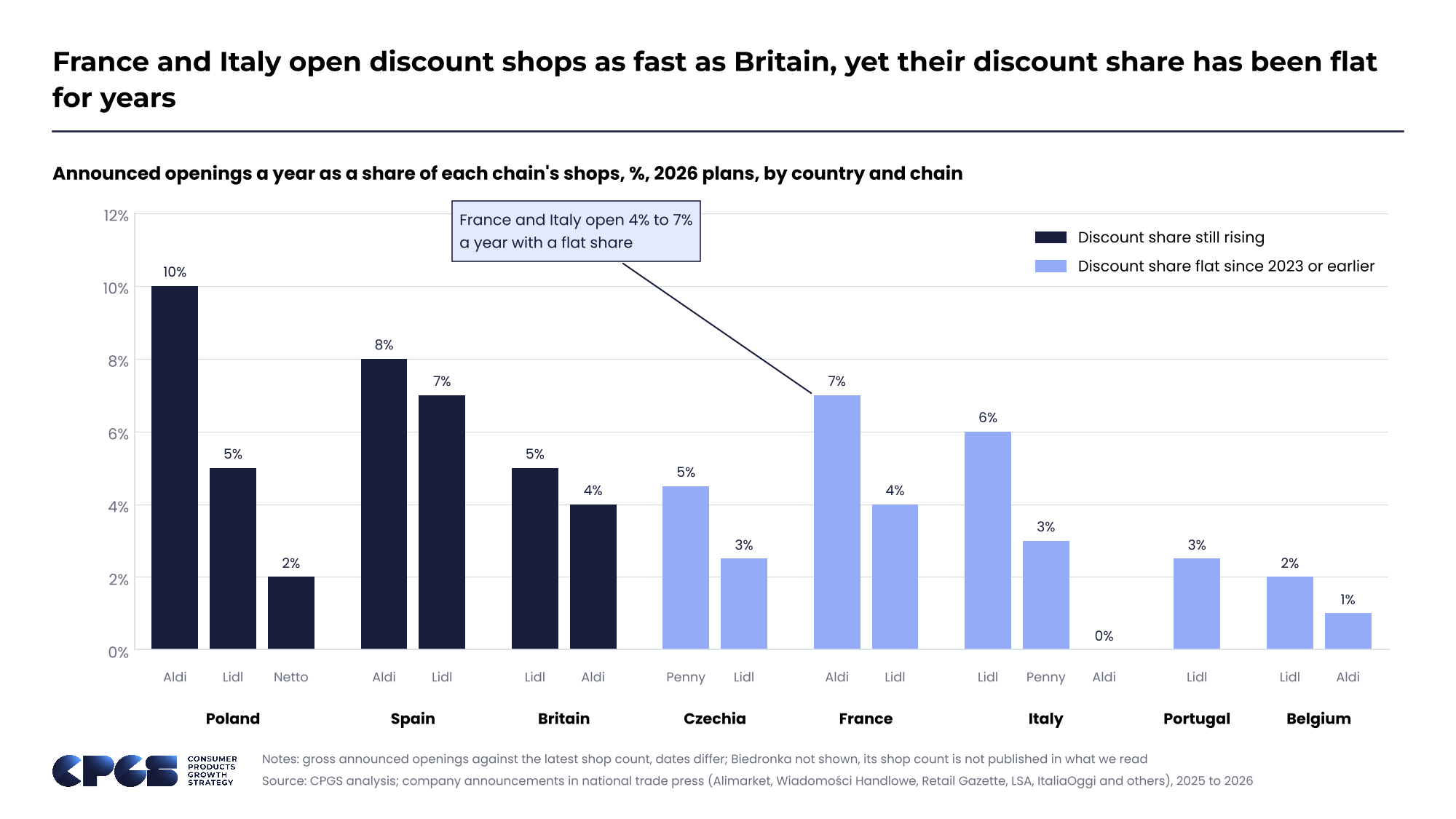
Source: CPGS analysis; company announcements in national trade press (Alimarket, Wiadomości Handlowe, Retail Gazette, LSA, ItaliaOggi and others), 2025 to 2026
In Britain, the same number of new shops has bought very different results. Since 2023 Aldi has added about 6% more shops, and its grocery market share has stayed at 11%. Lidl added about 5% more shops, and its share rose by a point, from 7% to 8%. Aldi's new shops mostly take sales from its existing ones, whose sales after inflation fall every year. Lidl's new shops win sales from other grocers (Worldpanel by Numerator, 12 weeks to September 2023 and 2025; Aldi Stores Ltd and Lidl Great Britain Ltd accounts).
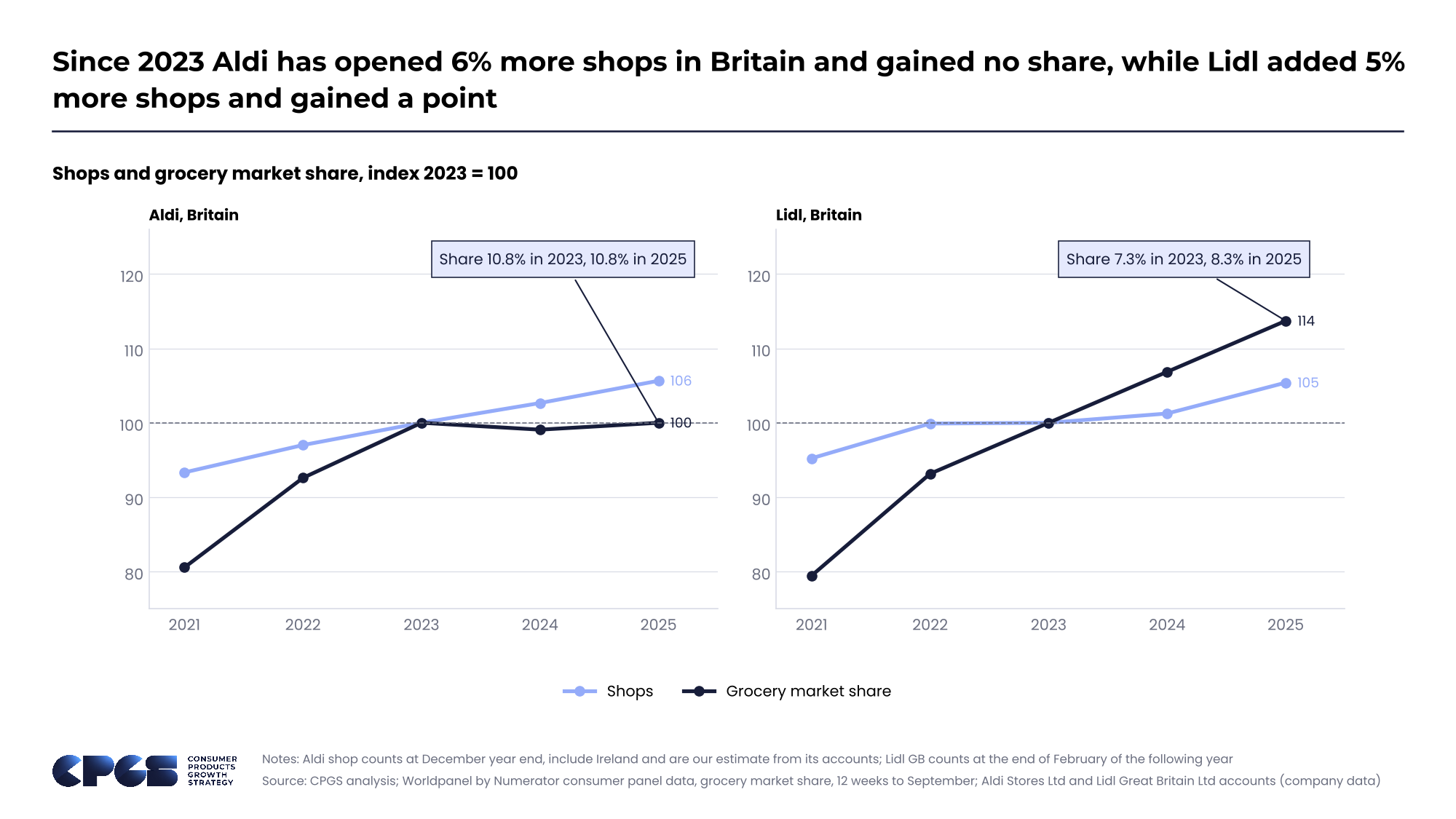
Source: CPGS analysis; Worldpanel by Numerator consumer panel data, grocery market share, 12 weeks to September; Aldi Stores Ltd and Lidl Great Britain Ltd accounts (company data)
IGD's forecast is right for the markets still growing, but too high for those that have stalled
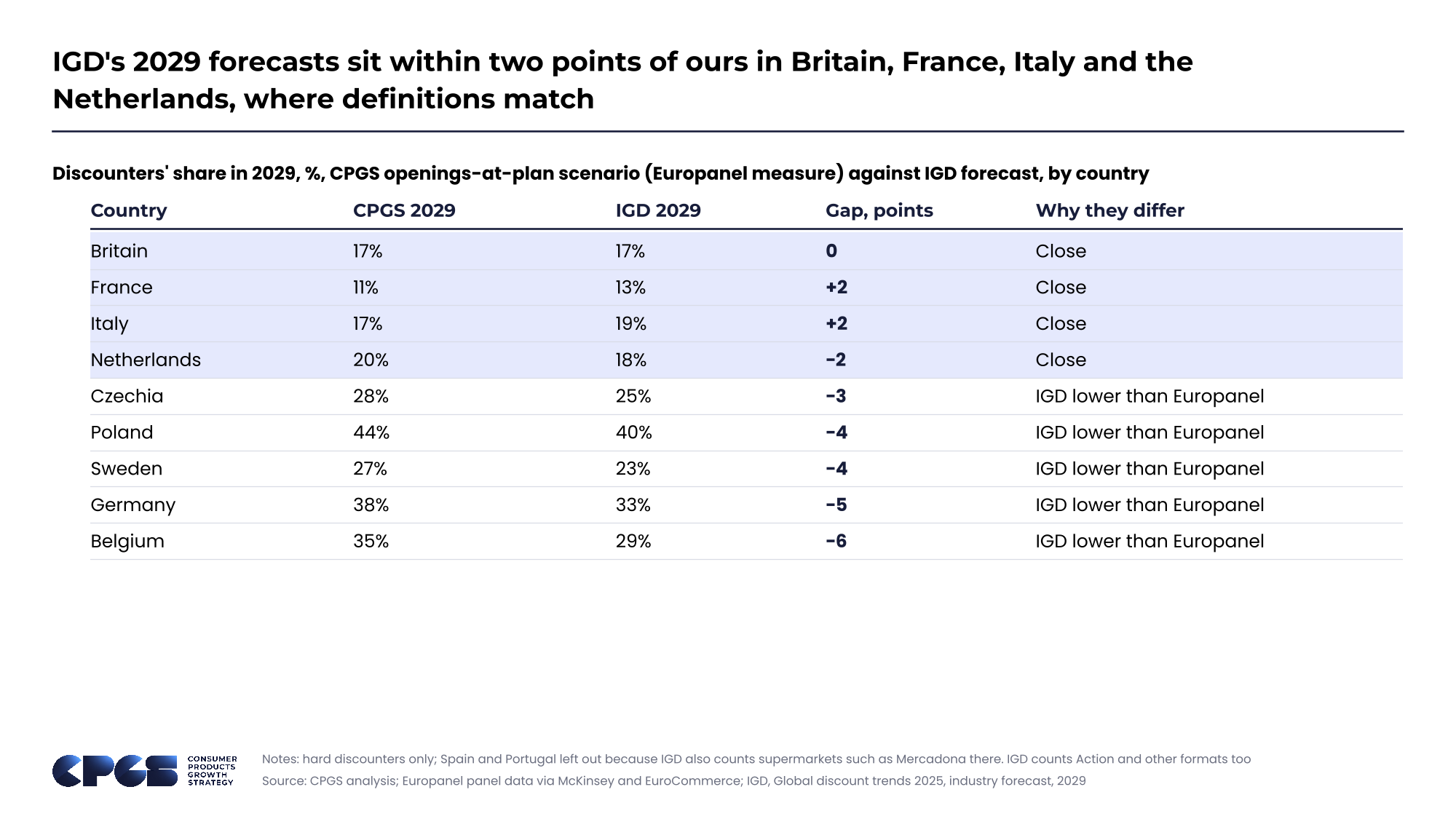
IGD expects the discount share across Europe to reach about 24% by 2030 (IGD, Global discount trends 2025). We agree with its view of the markets that are still growing. For 2029 it expects 17% in Britain and 18% in the Netherlands. For 2029 we expect about 17% in Britain, and about 20% in the Netherlands if its recent gain holds. In both, new discount shops still win share from other grocers, as Lidl's do in Britain.
We differ on the markets that have stalled. IGD expects 19% in Italy and 13% in France by 2029. We expect both to stay near today's 17% and 11%. Their chains have opened shops for years without gaining share, and in France Leclerc holds shoppers on price. So we put the eleven markets at 22% to 24% by 2031, with IGD's figure at the top of that range. Reaching it would need the stalled markets to climb again, and nothing in the data shows that yet. IGD also counts formats such as Action, and supermarkets such as Mercadona in Spain and Portugal, so we leave those two out of the comparison (CPGS analysis of Europanel shares, IGD space data and company opening plans).
Source: CPGS analysis; Europanel panel data via McKinsey and EuroCommerce; IGD, Global discount trends 2025, industry forecast, 2029
Only a new food price shock would take Europe much higher. In 2022 and 2023 discounters gained most where food prices rose fastest, and shoppers kept the gain when prices calmed. Food prices are expected to rise again, but more slowly. RaboResearch expects mid- to high-single-digit food inflation across Europe in 2027 (RaboResearch, June 2026). IGD expects 5% to 7% a year in Britain in 2027 and 2028 (IGD, Viewpoint, September 2026). That is about half the rise of 2022 and 2023. Food prices move the 2031 share about ten times more than store openings do (CPGS analysis). Price matching matters too. If a price leader such as Leclerc stopped matching discount prices, new discount shops there would start winning share again.
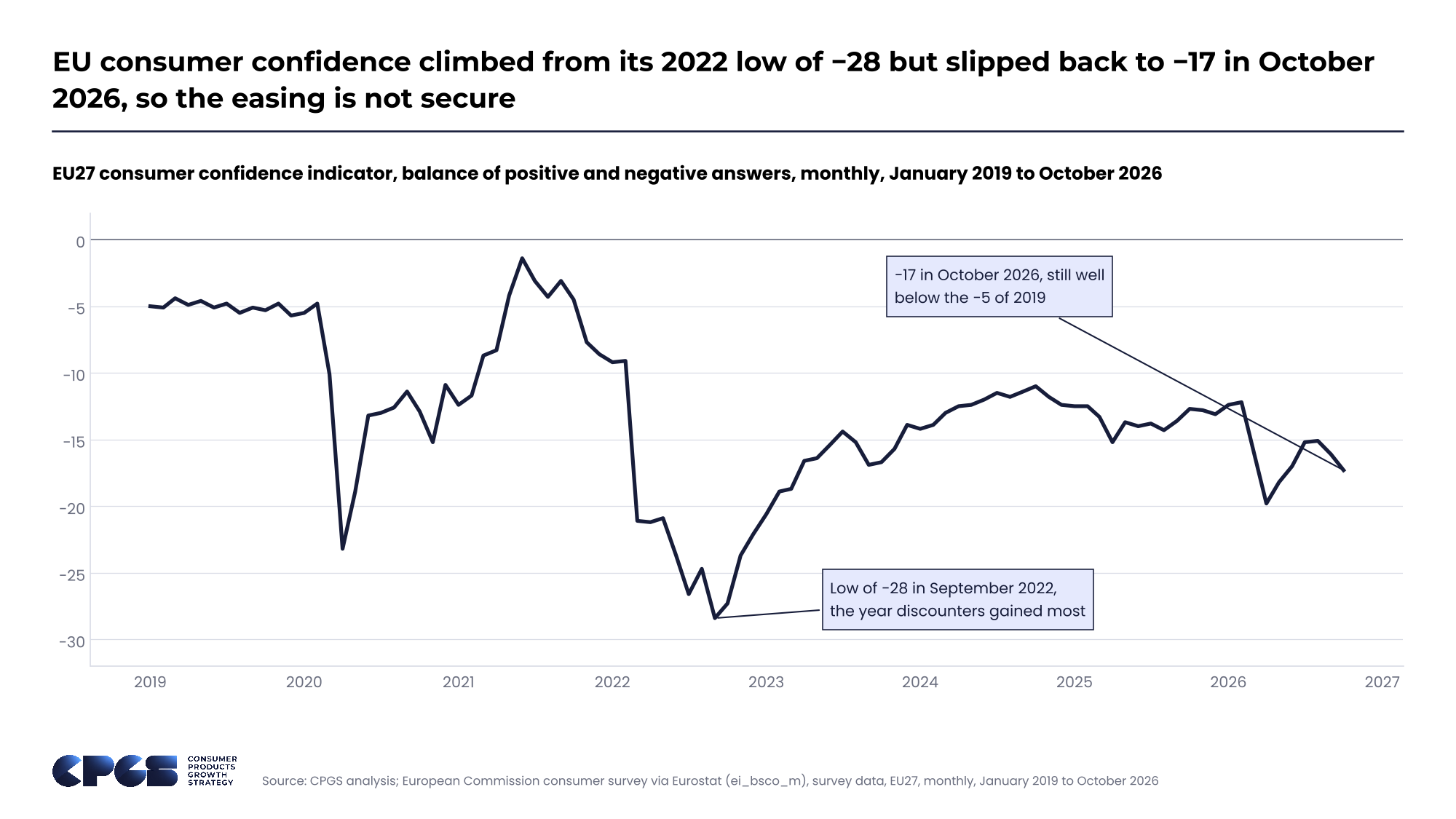
Shoppers who switched have stayed. In past downturns the discount share did not fall back once budgets recovered. Britain's share held at about 6% in 2009 and 2010, after the 2008 shock (Kantar Worldpanel, 2009 and 2010). German discount sales stalled in 2009 and fell in 2014, but their share never fell back far (Nielsen; GfK). Overall fewer shoppers now say they want to shop more at discounters. YouGov's EU-15 panel of 11,250 people shows net intention to shop more at hard discounters below its 2022 peak. The bigger risk is that discounters start gaining again. Once they win new shoppers, those shoppers stay. But it takes a food price shock to start that, and today there is no sign of one on the scale of 2022 and 2023. EU consumer confidence has slipped, to −17 in October 2026 from −12 in January, as energy costs rose (European Commission consumer survey via Eurostat). Food price forecasts point to rises about half as large as last time. So we expect discount shares to stay where they have stalled.
Source: CPGS analysis; European Commission consumer survey via Eurostat (ei_bsco_m), survey data, EU27, monthly, January 2019 to October 2026
We will track four readings. Jerónimo Martins' 2026 results, due early in 2027, will show whether Biedronka catches up on its opening plan. Eurostat's monthly food prices and the EU confidence index would show a new price shock early. In 2022 and 2023, discounters gained share in markets where food prices rose by more than about 18% in total over two years. If food prices rise that fast again, our range is too low. The price moves of Leclerc, Mercadona and Tesco will show whether the price leaders keep matching. Europanel's 2026 country shares, due in mid 2027, will show whether any stalled market moves. If one rises by half a point or more without a price shock, our view is wrong. The likeliest cause would be a step up in discount ranges or quality, as Aldi made in Britain from 2011.
For brand owners and their investors, the discount question has changed. In most of the eleven markets the channel will now grow only as fast as grocery as a whole. In the other four it grows only as fast as the discounters open shops. That does not make the channel less important. Discounters already take more than a third of grocery spending in Poland, Germany and Belgium, and more than a quarter in Czechia and Sweden. In those markets no brand can ignore them. If another price shock comes, the channel becomes the one that decides a brand's year, because the share discounters win in a shock does not come back. We think the stronger pressure on brand prices comes from the mainstream grocers that hold the discounters back, Leclerc, Mercadona and Tesco, because they do it by matching discount prices. Last time, discounters took about 2 points over 2022 and 2023 and kept it when prices calmed. So the decision that matters most is how a brand prices through the next food price shock, not how it plans for a steady drift to discount.
Sources
CPGS analysis: country discount shares 2020 to 2025 (2021 and 2023 published by Europanel, other years calculated from its growth rates), eleven-market weighting, openings scenarios to 2031
Europanel household panel data in McKinsey and EuroCommerce, The State of Grocery Retail Europe, editions 2022 to 2026, including IGD selling space data
Eurostat household food spending (2022) and European Commission consumer confidence indicator (monthly to October 2026); Defra, Agriculture in the UK 2022; Eurostat HICP food and ONS CPI food (official statistics), food prices 2019 to 2025
Worldpanel by Numerator, consumer panel: grocery market shares for Britain, France and Spain; Kantar, Britain discount share 2009 to 2012, via The Grocer (2010) and Just Food (April 2012); The Grocer, comment on Aldi Price Match schemes, 2025, from Kantar data
Competition and Markets Authority, Controlled Land Order provisional decisions on Aldi and Lidl, 7 August 2026
Brand Finance, Retail 100, 2026, brand valuation model; Kantar brand equity survey, Meaningful Different Salient framework, 2025
IGD, Global discount trends 2025, industry forecast; IGD Viewpoint, UK food inflation forecast, September 2026; RaboResearch, European food price outlook, June 2026
Nielsen and GfK, German discount sales and share, 2009 and 2014
UFC-Que Choisir, supermarket price survey 2025
YouGov, Behavior Change EU-15, spring-summer 2026 (11,250 people)
Company reports and calls: Jerónimo Martins (first nine months 2026, 28 October 2026), Axfood (Q3 2026 interim report, 22 October 2026), Tesco (interim results call, 8 October 2026), Carrefour (Q3 2026 sales release), Colruyt Group (full-year 2025/26 results, June 2026), Aldi Stores Ltd and Lidl Great Britain Ltd accounts, Lidl Spain results
Store counts and opening announcements, 2025 to 2026: company statements reported by Alimarket, El Español, Wiadomości Handlowe, money.pl, Retail Gazette, Grocery Gazette, LSA, ItaliaOggi, ESM, RetailDetail and arecenze.cz
